#MMT
Tariffs and Trade Wars: A Comprehensive Guide to Who Really Pays
AFFILIATE DISCLOSURE: This site does not currently have affiliate partnerships. All content is independently researched and written to provide you with accurate, unbiased financial information.
Tariffs have moved from the back pages of economics textbooks to the front pages of daily news — and for good reason. In 2025 and 2026, the United States launched what many economists are calling the most sweeping tariff regime since the 1930s. Whether you are a business owner, an investor, or simply a consumer trying to manage a household budget, tariffs are now directly affecting your wallet in ways that are measurable, documented, and accelerating.
They influence the prices of everyday goods, reshape international relations, and can determine the trajectory of entire economies. But what exactly are tariffs? How do they work? And when a trade war erupts, who ultimately foots the bill?
This comprehensive guide merges economic theory with real-world 2025–2026 data — explaining everything you need to know about tariffs, trade wars, and how to protect your finances.
What Are Tariffs?
At its core, a tariff is a tax imposed by a government on imported goods and services. When a company imports a product from another country, it must pay this tax to the domestic government before the goods can clear customs and enter the market.
Governments typically use tariffs for two main purposes:
- To Protect Domestic Industries: By making imported goods more expensive, tariffs encourage consumers to buy locally produced alternatives — a policy known as protectionism.
- To Generate Revenue: Historically, before the widespread adoption of income taxes, tariffs were a primary source of revenue for national governments. Today, they are again being used explicitly as a revenue tool.
The Three Types of Tariffs
| Tariff Type | How It Works | Example |
|---|---|---|
| Specific Tariffs | A fixed fee per unit of an imported good | A $500 tax on every imported car, regardless of its value |
| Ad Valorem Tariffs | A percentage of the imported good’s value | A 10% tax on imported steel worth $100,000 = $10,000 tariff |
| Compound Tariffs | A combination of both specific and ad valorem | A $1/lb tax plus a 5% tax on the total value of imported cheese |
The 2025–2026 Trade War: What Actually Happened
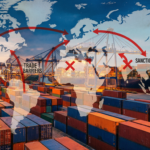
To understand who pays for tariffs, it helps to look at the largest real-world experiment in modern trade policy. On April 2, 2025 — dubbed “Liberation Day” — the Trump administration announced sweeping tariffs on virtually all U.S. trading partners under the International Emergency Economic Powers Act (IEEPA).
The effective U.S. tariff rate skyrocketed from close to 3% in early January 2025 to 28% post-Liberation Day, and now sits at roughly 14–16% following various revisions, delays, and court rulings. (American Action Forum)
In February 2026, the U.S. Supreme Court struck down the IEEPA tariffs as unlawful — but the administration responded immediately by imposing new 10% tariffs on all imports under Section 122 of the Trade Act of 1974, keeping the trade war firmly in place.
The Trump tariffs represent the largest U.S. tax increase as a percentage of GDP since 1993, amounting to an average tax increase of $1,500 per U.S. household in 2026. (Tax Foundation)
The Hidden Costs: Who Ultimately Pays?
A common political claim is that the exporting country “pays” the tariff. Economically, this is false — and the data from 2025 proves it conclusively.
1. Consumers Pay at the Register
The 2025 tariffs raised an estimated $194.8 billion in inflation-adjusted customs revenue above the pre-tariff average as of January 2026, with imported core goods prices rising 1.3% and durable goods prices rising 1.4% during 2025. (The Budget Lab at Yale)
The tariffs disproportionately affect metals, leather, and apparel products, with consumers facing price increases of between 28% and 40% in the short run — prices that remain 10% to 14% higher even in the long run.
2. Low-Income Households Are Hit Hardest
This is perhaps the most underreported dimension of tariff policy. The tariff burden on households in the second-lowest income decile is 2.5 times as large as a share of income compared to households in the top income decile. For a household in the second-lowest income bracket, the 2025 tariff policies led to an annual consumer loss of around $980, rising to $1,700 for middle-income households. (The Budget Lab at Yale)
In other words, tariffs function as a regressive tax — the less you earn, the harder they hit.
3. Businesses Face Higher Production Costs
Many imported goods are raw materials or components used by domestic manufacturers. Tariffs on imported aluminum raise costs for automakers. Tariffs on imported semiconductors raise costs for electronics manufacturers. These higher input costs squeeze margins, which can lead to hiring freezes, wage stagnation, or layoffs — even in industries the tariffs were ostensibly designed to protect.
4. Exporters Suffer from Retaliation
Trade is a two-way street. Retaliatory tariffs from U.S. trading partners affect an estimated $223 billion of U.S. exports (Tax Foundation) — hitting American farmers, manufacturers, and service exporters who had no role in the original trade dispute.
Winners and Losers: Not All Sectors Are Equal
The economic impact of tariffs is not uniform. In the long run, U.S. manufacturing output expands by approximately 2.5% under the current tariff regime — but these gains are more than offset by contractions elsewhere: construction output falls by 3.8% and agricultural output declines by 0.3%. (The Budget Lab at Yale)
This means tariffs create a deliberate transfer of economic activity — from agriculture, construction, and services toward manufacturing — with significant job losses in the sectors that lose, and no guarantee that the jobs created in manufacturing offset them on a scale or timeline that works for displaced workers.
What Is a Trade War?
A trade war occurs when two or more countries escalate tariffs and trade barriers against each other in a cycle of retaliation. The 2025 U.S.–China confrontation illustrates the stakes: U.S. tariffs on Chinese imports reached as high as 145% before being scaled back to 30%. China retaliated with its own sweeping tariffs and export controls on critical materials.
The broader consequences of trade wars include:
- Supply Chain Disruption: Global supply chains are deeply integrated across borders. Trade wars force companies to rapidly find alternative suppliers — a process that is expensive, time-consuming, and inflationary.
- Market Volatility: Uncertainty surrounding trade policy caused significant stock market swings throughout 2025. Retirement accounts and investment portfolios felt the turbulence regardless of whether individuals were directly employed in affected industries.
- Slower Economic Growth: All 2025 U.S. tariffs combined with foreign retaliation lower real GDP growth by approximately 0.5 percentage points in both 2025 and 2026, with the U.S. economy persistently 0.4% smaller in the long run — equivalent to $125 billion annually in lost output. (The Budget Lab at Yale)
- Legal Uncertainty: The Supreme Court’s February 2026 ruling against IEEPA tariffs created significant uncertainty for businesses that had built their 2026 pricing, supply chain, and hiring plans around a specific tariff landscape — only to find it legally contested and partially reversed.
The Macroeconomic Scorecard So Far
| Metric | Impact |
|---|---|
| Average effective tariff rate | Rose from ~3% (Jan 2025) to 28% peak; now ~10–16% |
| Cost per household (2026) | ~$1,500 average; up to $3,800 at peak tariff levels |
| Tariff revenue collected | ~$194.8B above pre-tariff baseline (through Jan 2026) |
| U.S. GDP impact | -0.5pp growth reduction per year in 2025–2026 |
| Unemployment rate impact | +0.7 percentage points higher by end of 2026 |
| Payroll employment | ~490,000 jobs lower by end of 2025 |
| U.S. exports affected by retaliation | $223 billion |
How to Protect Your Finances During a Trade War
- Diversify your investments: Companies heavily reliant on international supply chains or foreign sales are most vulnerable during trade disputes. Spreading exposure across sectors and geographies reduces concentration risk.
- Anticipate inflation in specific categories: Tariffs are not uniformly inflationary. Apparel prices rose approximately 17% under the combined 2025 tariff regime — a significant impact for households budgeting for back-to-school shopping or clothing purchases. Factor targeted price increases into your household planning.
- Build an emergency fund: Trade wars can trigger targeted job losses in specific industries — agriculture, construction, and import-dependent manufacturing have all been affected. A robust emergency fund — ideally three to six months of expenses — provides critical insulation if your sector is impacted.
- Buy big-ticket items strategically: If you are considering a major purchase — car, appliance, electronics — tariffs are likely already embedded in current retail prices. Prices in some categories may moderate if tariff rates are reduced through future trade deals; in others, prices may rise further if pharmaceutical and electronics tariffs are implemented.
How This Impacts You
Tariffs are not an abstract policy debate — they are a direct transfer of money from your household to the federal government, dressed up in the language of patriotism and fair trade. Here is what the current trade environment means for your specific situation:
- As a consumer: You are already paying more. Clothing, electronics, appliances, cars, and construction materials are all more expensive than they would be without tariffs. There is broad consensus among economists that U.S. businesses and consumers bear the vast majority of tariff costs, and that 2026 will continue to see upward pressure on consumer prices.
- As a worker: Your job security depends heavily on which industry you’re in. Manufacturing workers may see short-term stability or gains. Agricultural workers, construction workers, and those in import-dependent industries face real headwinds.
- As a small business owner: If any of your inputs, materials, or finished goods cross a border, you are directly exposed. Building supplier diversification into your operations is now a core risk management strategy.
- As an investor: The stock market has demonstrated repeatedly that tariff announcements move prices significantly. Companies with diversified global supply chains and strong pricing power tend to weather trade wars better than those dependent on single-country sourcing.
- As a citizen: Understanding that tariffs are ultimately paid by domestic consumers — not foreign governments — is essential for evaluating the real costs of trade policy.
Frequently Asked Questions
1. Do foreign countries pay the tariffs imposed on them?
No — this is one of the most persistent economic myths in policy debates. Tariffs are paid by domestic importing companies at the border. Historical evidence consistently shows tariffs raise prices and reduce available goods for U.S. businesses and consumers, resulting in lower income and reduced employment. (Tax Foundation)
2. Why do governments impose tariffs if they hurt consumers?
Governments use tariffs to protect specific domestic industries from foreign competition, to save jobs in politically important sectors, to generate federal revenue, and as leverage in international trade negotiations. The benefits are concentrated and visible (a saved factory); the costs are diffuse and less visible (slightly higher prices for everyone).
3. What is the difference between a tariff and a quota?
A tariff is a tax on imported goods that raises their price. A quota is a strict physical limit on how much of a specific good can be imported regardless of price. Tariffs generate government revenue; quotas do not.
4. How do tariffs cause inflation?
By taxing imports, tariffs directly raise the cost of imported goods. Domestic producers then raise their own prices because they face less price competition from abroad. This dual effect — higher import prices plus reduced competitive pressure on domestic prices — pushes the general price level higher, contributing to inflation.
5. Can a trade war cause a recession?
Yes. Economic modeling of the 2025 tariff regime projects that real wages in the U.S. could decline by 1.4% by 2028, with GDP falling by approximately 1% under sustained elevated tariffs with full foreign retaliation. The combination of higher consumer prices, disrupted supply chains, reduced exports, and elevated uncertainty is a recipe for significantly slower growth — and under the right conditions, recession.
Internal Resources Worth Reading
- What Happens If the Dollar Loses Reserve Currency Status?
- How the Federal Reserve Controls Inflation
- Universal Basic Income: Pros, Cons, and Its Impact on the Economy
- The Rise of Economic Populism: What It Means for Money and Markets
External Sources
Is Inflation Always Bad? What MMT Says About Price Stability
The Debt Myth: Why Government Borrowing Isn’t Like a Household Budget
AFFILIATE DISCLOSURE:
This article contains affiliate links. We may receive a commission for purchases made through these links, at no extra cost to you. We only recommend products and services we believe will genuinely help you achieve your financial goals.
Discover why comparing government borrowing to a household budget is misleading—and how understanding the truth can change your financial perspective.
Introduction: Are We Being Misled About Government Debt?
You’ve probably heard it a hundred times: “The government needs to balance its budget just like a household does.” It sounds reasonable—responsible even. But here’s the truth: this comparison is not just misleading—it’s harmful. It promotes fear-based policies, stifles investment in public services, and keeps everyday people in the dark about how money and debt really work.
In this article, we’ll pull back the curtain on the debt myth, reveal how government borrowing actually works, and explain why you don’t need to panic every time you hear about “trillions in debt.” You’ll walk away with greater confidence in navigating financial conversations—and a clearer picture of how money works on both the personal and national level.
Table of Contents
- The Debt Myth: A Popular but Flawed Analogy
- How Government Debt Really Works
- What Makes Sovereign Governments Different
- Long-Term Deficits and the Economy
- Trending Mythbuster: Will Printing Money Cause Hyperinflation?
- How Misinformation Shapes Public Policy
- What This Means For You
- Downloadable Resource: Government Debt vs. Household Budget Checklist
- Conclusion: Empowering Your Financial Lens
- FAQ: Real Questions, Real Answers
- SEO Keywords and Hashtags
- Quora Traffic Booster Q&A
- Pinterest Pin Copy Ideas
The Debt Myth: A Popular but Flawed Analogy
The idea that the government must “live within its means,” just like a family budget, is emotionally appealing. But it ignores one massive truth:
A household uses money. A government creates it.
Here’s why the analogy breaks down:
Household Budget Government Budget
Must earn or borrow income before spending Can issue currency before collecting taxes
Cannot create money Has a central bank that creates sovereign currency
Debt must be repaid or defaulted Can roll over debt indefinitely or monetize it
Runs out of money if overspent Cannot run out of its own currency
This doesn’t mean governments can spend infinitely—but it does mean the rules are different.
How Government Debt Really Works
Governments like the U.S., U.K., Japan, and Canada are monetary sovereigns, meaning they issue their own currencies. This gives them unique tools:
They Don’t Need to “Save” Before spending
When Congress approves spending, the Treasury instructs the Fed to credit bank accounts. The government creates money by keystroke—not by pulling coins from a vault.
Debt Is Issued for Other Reasons
U.S. Treasury bonds don’t fund spending—they manage interest rates and offer a safe asset. As economist Stephanie Kelton writes in The Deficit Myth, the government issues bonds not because it needs money, but because it chooses to offer a safe place for savings.
Authoritative Source: Congressional Budget Office (CBO): Budget Concepts and Budget Process
What Makes Sovereign Governments Different?
Here are three key reasons why sovereign debt isn’t like household debt:
- Sovereign Currency Issuers Can’t Go Broke
Countries like the U.S. can never “run out” of dollars. Unlike Greece (which uses the euro), America borrows in a currency it controls.
- Debt Is Someone Else’s Asset
Every government liability is a private sector asset. When the government “goes into debt,” the public ends up holding the money.
Case in point: U.S. Treasury bonds are among the safest savings vehicles in the world.
- Budget Deficits = Private Sector Surpluses
A deficit in government spending means someone else received that money. In macroeconomic terms:
Government Deficit + Private Surplus + Foreign Surplus = 0
This accounting identity is used in Modern Monetary Theory (MMT) to show that deficits are often necessary for healthy economies.
Long-Term Deficits and the Economy
Aren’t Large Deficits Bad for the Future?
Not necessarily. The question isn’t “How much is too much?”—it’s:
“Are we using the deficit to create real value?”
Good deficit spending:
- Improves infrastructure
- Funds education and healthcare
- Supports job creation
- Reduces inequality
Bad deficit spending:
- Inflates asset bubbles
- Supports corporate bailouts without accountability
Trusted Source: Federal Reserve Bank of St. Louis: Deficits and Debt
Trending Mythbuster: Will Printing Money Cause Hyperinflation?
Does government printing money lead to hyperinflation?
This is one of the most common fears. Let’s address it head-on.
The Truth:
- Hyperinflation is rare and tied to supply collapse, war, or loss of monetary control (e.g., Zimbabwe, Weimar Germany).
- In the U.S., trillions were created during COVID—and inflation rose later, due to supply chain disruptions and price gouging, not just money printing.
It’s not about the amount of money—it’s about what the economy can produce.
When the economy has unused capacity (like during a recession), more money can actually help.
How Misinformation Shapes Public Policy
By promoting the household analogy, leaders justify:
- Austerity cuts to public services
- Fear-driven policies that prevent investment
- Privatization of public assets
This fear-based approach hurts working families—especially during downturns.
We’ve Seen It Before:
- 2010s Austerity in Europe slowed growth and hurt employment.
- U.S. “Fiscal cliffs” and shutdown threats created unnecessary crises.
What This Means For You
Understanding the truth about government debt helps you:
✅ Cut through political spin
✅ Advocate for policies that support people—not panic
✅ Reframe your own financial strategies without internalizing false guilt from national debt fear
Free Download: Government Debt vs. Household Budget Checklist
Get a one-page printable guide that breaks down:
- Key differences between household and government budgets
- 3 questions to ask when you hear about the national debt
- How to explain this to friends or family
Click here to download the free checklist
Also explore: Understanding Money 101: Your Guide to Managing Finances With Confidence
Conclusion: Empowering Your Financial Lens
The national debt is not your credit card bill—and it shouldn’t control your financial peace of mind.
By understanding how sovereign money systems really work, you can see through fear-based narratives and advocate for smarter, people-focused policy.
Let’s reject the myths and embrace a more financially literate, empowered future—one where both public and personal budgets are tools for building value, not excuses for cuts.
FAQ: Real Questions, Real Answers
1. Is government debt ever a real problem?
- Yes—if it’s used wastefully or fuels inequality. But it’s not inherently dangerous.
2. Why can’t the government just print unlimited money?
- Because the limit is inflation, not bankruptcy.
3. What is Modern Monetary Theory?
- A framework that rethinks the role of deficits and shows how currency-issuing governments operate.
4. Didn’t money printing cause inflation recently?
- COVID-related inflation was more about supply chain disruptions and corporate pricing.
5. Can the U.S. default on its debt?
- Technically no, unless it chooses to—like during a political standoff.
6. What happens if the government runs a surplus?
- The private sector must run a deficit—losing income and savings.
7. Are taxes needed to fund spending?
- Not directly. Taxes help control inflation and manage demand.
8. Why do politicians push debt fear?
- Often to justify cutting social programs or promoting austerity.
9. Should I worry about the national debt for my retirement?
- No. Focus on personal finances, not myths about public debt.
10. How can I learn more?
- Start with Parasistem and the Sovereign Money System
Affiliate Disclosure
Some of the links in this article may be affiliate links. If you choose to make a purchase through them, we may earn a small commission — at no extra cost to you. We only recommend tools and resources we trust. Thank you for supporting TheMoneyQuestion.org!