How Debt Consolidation Loans Work: A Beginner’s Guide

It can be very difficult to manage several obligations, particularly when you’re balancing personal loans, high-interest credit cards, and medical expenses. By consolidating several obligations into a single monthly payment, debt consolidation loans provide a means of streamlining your finances. For beginners, understanding how these loans work, their benefits, risks, and alternatives is key to making informed financial decisions. Everything is explained in plain language in this guide.
Quick Summary: How Debt Consolidation Loans Work
- Purpose: Combine multiple high-interest debts into one predictable monthly payment.
- Main Benefit: Lower interest costs and simplified budgeting.
- Best For: Borrowers with steady income who want to pay off debt in full.
- Key Requirements: Fair credit, manageable debt-to-income ratio, and stable cash flow.
- Risks: Longer repayment terms may increase total interest paid.
- Outcome: With consistent payments, consolidation can improve your credit over time.
What Is a Debt Consolidation Loan and How Does It Work?
For many people, managing multiple credit cards, personal loans, and medical bills can feel like an endless juggling act. A debt consolidation loan is designed to eliminate this stress by taking all your debts and rolling them into one single loan. Instead of remembering multiple due dates, interest rates, and payment amounts, you’ll make a single monthly payment to just one lender.
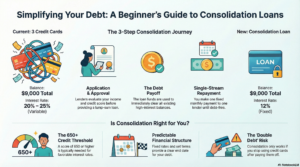
A debt consolidation loan is fundamentally a type of personal loan. The lender gives you a lump sum payment, which you use to pay off your existing debts. Once those debts are cleared, you’re left with only the consolidation loan to repay. Depending on your creditworthiness, you may secure a lower interest rate than what you were paying before — see how much you can save with real examples.
Here’s a simple breakdown of how it works:
- Application: You apply to a bank, credit union, or online lender. The lender looks at your income, bills, and credit score.
- Approval: If approved, the lender provides a lump sum loan. Some lenders pay your creditors directly, while others deposit funds into your account.
- Payoff: You use the loan profits to pay off your bills, including credit card balances and other high-interest loans.
- Repayment: You make a fixed monthly payment on the consolidation loan until it is fully repaid.
To illustrate, imagine you have three credit cards:
| Debt Type | Balance | Interest Rate | Monthly Payment |
| Credit Card A | $3,000 | 20% | $150 |
| Credit Card B | $4,000 | 22% | $200 |
| Credit Card C | $2,000 | 25% | $100 |
Total owed: $9,000 with varying high interest rates.
If you consolidate with a $9,000 personal loan at 12% interest over 4 years, your monthly payment may drop, and you’ll save money on interest compared to juggling three high-interest cards.
This arrangement gives you a precise timeframe for debt freedom and simplifies paying.
Key takeaway: Debt consolidation loans simplify repayment by combining multiple debts into one fixed-payment loan, often at a lower interest rate:
The Benefits and Drawbacks of Debt Consolidation
Debt consolidation loans can be appealing, but they’re not perfect for everyone. To make the right choice, it’s important to weigh the pros and cons carefully.
Benefits of Debt Consolidation Loans
- Simplified payments: Instead of multiple creditors and due dates, you’ll only manage one payment each month.
- Lower interest rates: You can get a cheaper rate than your current credit cards if your credit score is high, which lowers your total interest expenses.
- Predictable payments: Most debt consolidation loans come with fixed interest rates and set repayment terms, which means your payment stays the same until the loan is paid off.
- Potential credit score improvement: Paying off high-interest revolving debt like credit cards can reduce your credit utilization ratio, boosting your credit score — learn how to improve your credit score with debt consolidation.
- Emotional relief: Consolidation can reduce financial stress by providing a sense of structure and control.
Drawbacks of Debt Consolidation Loans
- Upfront costs: Some lenders charge origination fees, balance transfer fees, or prepayment penalties.
- Longer repayment terms: Lower monthly payments may seem attractive, but stretching repayment out for more years could increase the total interest you pay.
- Risk of new debt: If you don’t change spending habits, you may rack up new balances on cleared credit cards, worsening your financial situation.
- Credit requirements: Borrowers with poor credit may only qualify for high interest rates, reducing the benefit of consolidation.
Here’s a quick comparison:
| Factor | Benefit | Drawback |
| Monthly Payments | One simplified payment | Could last longer than the original debts |
| Interest Rates | Often lower than credit cards | Higher if the credit score is poor |
| Credit Score Impact | Can improve over time | A rigorous investigation could result in a brief decline. |
| Financial Discipline Needed | Encourages structured repayment | Risk of falling back into bad habits |
Key takeaway: Debt consolidation loans can save money and simplify finances, but success depends on disciplined repayment and avoiding new debt:
Who Should Consider a Debt Consolidation Loan?
Debt consolidation isn’t a one-size-fits-all solution. It works well for certain borrowers, but others may be better off exploring alternative debt relief strategies.
Ideal Candidates for Debt Consolidation Loans
- Borrowers with multiple high-interest debts, especially those struggling with credit card balances charging 18% to 25%.
- People with good to excellent credit scores: A score of 650 or higher can often qualify you for favorable rates.
- Individuals with steady income: Regular income ensures you can handle the monthly payments.
- Those seeking simplicity: Managing one loan is easier than tracking multiple accounts.
- Borrowers aiming to pay off debt faster: With a structured repayment plan, consolidation can accelerate progress.
Who Should Avoid Debt Consolidation Loans
- Unstable earners: If your income is irregular or at risk, taking on a consolidation loan could lead to missed payments.
- Borrowers with very low debt amounts: If you only owe a small balance, consolidation may not be worth the fees.
- Those with poor credit: High-interest consolidation loans may not improve your situation.
- Undisciplined spenders: If you continue using your credit cards after consolidating, you risk doubling your debt load.
Here’s a quick way to decide:
| Scenario | Best Approach |
| High credit card debt + good credit score | Debt consolidation loan |
| Small total debt, manageable payments | Direct repayment without consolidation |
| Poor credit, limited income | Explore a credit counseling or debt management plan. |
| Ongoing overspending habits | Focus on budgeting before consolidation. |
Key takeaway: Debt consolidation is best suited for financially stable borrowers with good credit who are committed to disciplined repayment.
The Complete Guide to Applying for a Debt Consolidation Loan
Although applying for a debt consolidation loan can seem daunting, the procedure is straightforward and organized. Being prepared can improve your chances of approval and help you secure the most favorable terms.
Step-by-Step Guide
- Check your credit report — unfamiliar with the terminology? See our complete glossary.
Review your credit score and history for errors. You can check your credit report for free at Experian. Lenders use this to decide eligibility and interest rates.
- Calculate your total debts.
Add up balances, interest rates, and monthly payments. Knowing the total loan amount you’ll need prevents under-borrowing.
- Compare lenders
Research banks, credit unions, and online lenders. Look at interest rates, repayment terms, fees, and customer reviews.
- Gather documentation
Prepare the following documents: income verification (pay stubs or tax returns), proof of employment, government-issued ID, and debt details.
- Submit your application
Apply in person. Expect a hard credit check, which may temporarily affect your credit score.
- Receive approval and loan funds.
If approved, you’ll either receive the money directly or the lender will pay your creditors on your behalf.
- Pay off existing debts.
Ensure all balances are cleared to avoid double payments or unexpected charges.
- Follow your repayment plan.
Make payments on time every month until the loan is repaid. Consider setting up autopay to avoid missed payments.
Pro Tips for a Successful Application
- Before committing, compare rates; even a tiny variation might result in hundreds of dollars in savings throughout the loan.
- Applying to too many lenders at once can have a negative effect on your credit score because of the numerous hard inquiries.
- Stay disciplined after consolidation by avoiding new high-interest debt.
Key takeaway: Applying for a debt consolidation loan is straightforward, but preparation and lender comparison are key to getting favorable terms:
Alternatives to Debt Consolidation Loans You Should Know
While debt consolidation loans are popular, they’re not always the best choice. Depending on your credit score, debt amount, and goals, alternatives may be more effective.
Common Alternatives
- Balance transfer credit cards: Ideal if you have good credit. Many offer 0% APR for 12–18 months, giving you time to pay down debt interest-free. However, they often charge balance transfer fees.
- Debt management plans (DMPs): Managed by credit counseling agencies, these plans consolidate payments through the agency, which negotiates lower interest rates with your creditors.
- Debt settlement involves negotiating a lower payment amount with creditors. While this reduces debt, it harms your credit score and may come with fees.
- Home equity loan or HELOC: Low interest rates are available if you own a property and can borrow against its equity. However, defaulting puts your home at risk.
- Bankruptcy: Bankruptcy is a last resort that can discharge some debts, but it has long-term detrimental effects on credit and financial stability.
Quick Comparison of Alternatives
| Option | Best For | Risks/Downsides |
| Balance transfer card | Good credit + small debts | High fees, high interest after intro |
| Debt management plan | Moderate debt + need for guidance | Monthly fees, long repayment timeline |
| Debt settlement | Severe financial hardship | Major credit score damage |
| Home equity loan/HELOC | Homeowners with strong equity | Risk of foreclosure if you default |
| Bankruptcy | Extreme unmanageable debt | Severe, lasting credit damage |
Key takeaway: Debt consolidation loans aren’t the only option — alternatives like balance transfers, debt management plans, or even bankruptcy may fit certain situations better:
Conclusion
Debt consolidation loans can be an effective way to lower interest costs, ease debt repayment, and lessen stress. However, they require financial discipline and careful consideration of alternatives. For beginners, the key is understanding how these loans work, who benefits most, and how to apply strategically. With the right approach, debt consolidation can be the first step toward financial freedom.
Preparing Your Finances Before You Apply
A point that many beginners underestimate is the importance of preparing your finances before applying for a debt consolidation loan. Even small adjustments—like reducing discretionary spending for 30 to 60 days—can improve your cash flow and lower your credit utilization. Both of these factors can strengthen your loan application and help you qualify for better terms. Lenders want to see that you are actively taking control of your financial situation, and demonstrating consistent, responsible behaviour can make a meaningful difference.
It is also helpful to review your existing debts in detail before choosing a consolidation strategy. Make a list of every balance, interest rate, minimum payment, and remaining term. This gives you a clear baseline for comparing consolidation offers. Many borrowers discover that some debts are better left out of consolidation—especially if they already carry low interest rates or are close to being paid off. Consolidation works best when it replaces high-interest, long-term debt with a more efficient structure.
Building Long-Term Financial Resilience
Another factor to consider is how consolidation affects your long-term financial resilience. A single monthly payment is easier to manage, but it is equally important to build a buffer so you do not rely on credit cards again. Setting aside even a small emergency fund—$25 to $50 per week—can prevent you from undoing the progress you have made. The goal is not just to simplify your debt, but to break the cycle that created it.
Borrowers should also pay close attention to lender transparency. Reputable lenders clearly disclose fees, APR ranges, prepayment policies, and hardship options. If a lender makes it difficult to find this information, uses pressure tactics, or promises “guaranteed approval,” that is a red flag. Debt consolidation is a legitimate financial tool, but the industry also attracts predatory companies. Taking time to compare lenders protects you from unnecessary costs and stress. For guidance on identifying trustworthy lenders, the Consumer Financial Protection Bureau is an excellent starting point.
How Consolidation Affects Your Credit Score Over Time
It is equally important to understand how consolidation interacts with your credit score over time. While your score may dip slightly when the loan is first opened—due to the hard inquiry and the new account reducing your average account age—consistent on-time payments typically lead to steady improvement. This is because consolidation reduces your credit utilization, adds positive payment history, and replaces multiple revolving accounts with a single installment loan. For many borrowers, this creates a healthier credit profile within six to twelve months. You can read more about this process in our guide on how debt consolidation can improve your credit score.
Consolidation Is a Tool, Not a Magic Fix
Finally, remember that consolidation is a tool—not a magic fix. The real transformation comes from the habits you build afterward. Tracking your spending, reviewing your budget monthly, and setting clear financial goals all reinforce the progress you have made. Many people find it helpful to schedule a quarterly “money check-in” to review their debt balance, savings, and credit score. These small routines help you stay on track and ensure that consolidation becomes a turning point rather than a temporary reset.
Preparing Your Finances Before You Apply
A point that many beginners underestimate is the importance of preparing your finances before applying for a debt consolidation loan. Even small adjustments—like reducing discretionary spending for 30 to 60 days—can improve your cash flow and lower your credit utilization. Both of these factors can strengthen your loan application and help you qualify for better terms. Lenders want to see that you are actively taking control of your financial situation, and demonstrating consistent, responsible behaviour can make a meaningful difference.
It is also helpful to review your existing debts in detail before choosing a consolidation strategy. Make a list of every balance, interest rate, minimum payment, and remaining term. This gives you a clear baseline for comparing consolidation offers. Many borrowers discover that some debts are better left out of consolidation—especially if they already carry low interest rates or are close to being paid off. Consolidation works best when it replaces high-interest, long-term debt with a more efficient structure. Our guide on how much debt consolidation can save you includes worked examples that can help you run these numbers before you apply.
Building Long-Term Financial Resilience
Another factor to consider is how consolidation affects your long-term financial resilience. A single monthly payment is easier to manage, but it is equally important to build a buffer so you do not rely on credit cards again. Setting aside even a small emergency fund—$25 to $50 per week—can prevent you from undoing the progress you have made. The goal is not just to simplify your debt, but to break the cycle that created it.
Borrowers should also pay close attention to lender transparency. Reputable lenders clearly disclose fees, APR ranges, prepayment policies, and hardship options. If a lender makes it difficult to find this information, uses pressure tactics, or promises “guaranteed approval,” that is a red flag. Debt consolidation is a legitimate financial tool, but the industry also attracts predatory companies. Taking time to compare lenders protects you from unnecessary costs and stress. For guidance on identifying trustworthy lenders, the Consumer Financial Protection Bureau is an excellent starting point.
How Consolidation Affects Your Credit Score Over Time
It is equally important to understand how consolidation interacts with your credit score over time. While your score may dip slightly when the loan is first opened—due to the hard inquiry and the new account reducing your average account age—consistent on-time payments typically lead to steady improvement. This is because consolidation reduces your credit utilization, adds positive payment history, and replaces multiple revolving accounts with a single installment loan. For many borrowers, this creates a healthier credit profile within six to twelve months. You can read more about this process in our guide on how debt consolidation can improve your credit score.
Consolidation Is a Tool, Not a Magic Fix
Finally, remember that consolidation is a tool—not a magic fix. The real transformation comes from the habits you build afterward. Tracking your spending, reviewing your budget monthly, and setting clear financial goals all reinforce the progress you have made. Many people find it helpful to schedule a quarterly “money check-in” to review their debt balance, savings, and credit score. These small routines help you stay on track and ensure that consolidation becomes a turning point rather than a temporary reset.
Frequently Asked Questions
What credit score do I need for a debt consolidation loan?
Although some accept lower scores with higher credit rates, most lenders prefer a score of 650 or higher.
Can debt consolidation loans hurt my credit?
Initially, a hard credit inquiry may cause a small dip, but on-time payments and lower credit utilization can improve your score long term.
Do debt consolidation loans eliminate debt?
No, they restructured it into one loan. You still owe the money, but under different terms.
How long does it take to pay off a debt consolidation loan?
Typically, 2 to 7 years, depending on your loan term and payment schedule.
Where can I learn more about my rights as a borrower?
The Consumer Financial Protection Bureau (CFPB) provides free resources on debt consolidation, your rights as a borrower, and how to avoid scams.
Are debt settlement and debt consolidation loans interchangeable?
No, settlement reduces the amount owed through negotiation, while consolidation combines debts into one loan.
Every debt situation is unique. If you’d like a one-on-one consultation with Bruce Creighton, CPA — with 35 years of financial experience — to review your specific debt consolidation options, contact us here.
Leave a Reply