Who Really Owns Central Banks? Let’s Clear Up the Confusion

Central banks are often viewed as mysterious, all-powerful entities that pull the strings of the global economy behind closed doors. This perception has led to countless myths and conspiracy theories, particularly regarding who actually owns and controls them. The truth, however, is far more nuanced and grounded in structural design aimed at balancing public accountability with economic stability.
Understanding the ownership of central banks is crucial because these institutions serve as the backbone of a country’s economy. They manage the money supply, set interest rates, and act as the lender of last resort during financial crises. But who holds the keys to these powerful organizations? Let’s demystify the ownership structures of central banks and explore why it matters.
What Do Central Banks Actually Do?
AFFILIATE DISCLOSURE:
This article contains affiliate links. We may receive a commission for purchases made through these links, at no extra cost to you. We only recommend products and services we believe will genuinely help you achieve your financial goals.
Before diving into ownership, it is essential to understand the core functions of a central bank. While regular commercial banks provide services like savings accounts and loans to individuals and businesses, central banks operate on a macroeconomic level.
- Printing Money: They are responsible for creating and circulating the national currency, ensuring there is enough liquidity in the system.
- Controlling Inflation and Interest Rates: By adjusting interest rates and managing the money supply, central banks aim to keep inflation in check and prevent the economy from overheating or stalling.
- Regulating Financial Institutions: Central banks oversee commercial banks to ensure they maintain adequate reserves and follow regulations, protecting the broader financial system.
- Lender of Last Resort: During times of severe financial stress, central banks step in to provide emergency funding to failing institutions to prevent systemic collapse.
Famous examples of central banks include the Federal Reserve in the United States, the European Central Bank (ECB), and the Bank of England.
The Three Models of Central Bank Ownership
Ownership models for central banks vary significantly around the world. There is no single “correct” way to structure a central bank, and different countries have adopted models that best suit their historical and political contexts. Generally, these structures fall into three categories:
| Model | Description | Examples |
| Government-Owned | Fully owned by the national government. Profits are typically returned to the state treasury. | Bank of England, Reserve Bank of India (RBI), Bank of Canada, European Central Bank |
| Privately-Owned | Involves private shareholders, often commercial banks. However, these shareholders do not control monetary policy. | Federal Reserve System (USA) |
| Hybrid | A mix of public and private ownership, designed to balance national interests with independent oversight. | Swiss National Bank, Bank of Japan |
1. Government-Owned Central Banks
The most common model globally is full government ownership. In this structure, the central bank is a public institution, and its capital is entirely held by the state. The Bank of England, for example, was nationalized in 1946. Similarly, the Bank of Canada operates as a Crown corporation, meaning it is wholly owned by the federal government but operates with considerable independence from the political process. Any profits generated by these banks—often through interest on loans or government bonds—are handed back to the respective governments. This model emphasizes direct accountability to the public through elected officials.
2. Privately-Owned Central Banks
The concept of a “privately-owned” central bank often sparks the most confusion. The Federal Reserve System in the U.S. is the classic example. It consists of 12 regional Federal Reserve Banks, which are technically owned by the private commercial banks in their respective districts. These member banks are required to hold stock in their regional Fed.
However, this “ownership” does not equate to control. The private shareholders do not dictate monetary policy, nor can they sell or trade their shares. The true decision-making power lies with the Board of Governors in Washington, D.C., whose members are appointed by the President and confirmed by the Senate. The private ownership aspect is largely a structural legacy designed to ensure regional representation and keep the central bank somewhat insulated from day-to-day political pressures.
3. Hybrid Ownership Models
Some central banks blend public and private ownership. The Swiss National Bank (SNB) is a prime example. It is a joint-stock company where the majority of shares are held by public entities (Swiss cantons and cantonal banks), while the remaining shares are traded on the stock market and held by private individuals. Despite having private shareholders who receive a capped dividend, the SNB is governed by a strict mandate to serve the national interest, blending accountability with operational independence.
Debunking Common Myths About Central Banks
The complex structures of central banks, particularly those with private elements, have given rise to persistent myths.
- Myth: Central banks are controlled by secretive private elites. Even in systems with private shareholders, like the Federal Reserve, key monetary policy decisions are made by independent boards or government-appointed officials, not by private bankers seeking personal profit.
- Myth: Central banks operate without oversight. While central banks need operational independence to be effective, they are heavily audited and must regularly report to their governments or legislative bodies.
How Do Ownership Models Handle Political Influence?
A major concern with central banks is how they manage political pressure, especially since their decisions can make or break an economy. The ownership model plays a significant role in this dynamic:
- Government-Owned: Because these banks are fully owned by the state, there is a higher risk of political interference. Politicians might pressure the bank to lower interest rates before an election to create a short-term economic boom, even if it risks long-term inflation. To counter this, countries like Canada and the UK have established strict legal frameworks that grant their central banks operational independence, separating day-to-day monetary policy from political whims.
- Privately-Owned: The inclusion of private shareholders acts as a structural buffer against direct government control. In the U.S. Federal Reserve, for example, the regional banks are owned by private member banks, which helps decentralize power away from Washington. However, the overarching Board of Governors is still politically appointed, ensuring the bank remains accountable to the public rather than private interests.
- Hybrid: These models attempt to strike a balance by distributing ownership among public entities and private investors. The Swiss National Bank’s structure ensures that no single political party or private group can monopolize decision-making, fostering a highly independent environment focused on long-term stability.
How Central Bank Policies Impact the Average Person
While central banks operate at the highest levels of the financial system, their decisions ripple down to affect the daily lives of everyday people. The most direct impact is felt through interest rates. When a central bank raises its benchmark interest rate to combat inflation, commercial banks follow suit. This means higher costs for mortgages, auto loans, and credit card debt, leaving consumers with less disposable income. Conversely, when the central bank lowers rates to stimulate a sluggish economy, borrowing becomes cheaper, encouraging people to buy homes and businesses to expand and hire more workers.
Beyond borrowing costs, central bank policies directly influence inflation and purchasing power. If a central bank increases the money supply too rapidly, the value of the currency can drop, causing the prices of everyday goods—like groceries and gas—to skyrocket. On the other hand, effective monetary policy keeps inflation stable and predictable, protecting the value of your savings and ensuring that your paycheck stretches just as far tomorrow as it does today. Ultimately, the central bank acts as the thermostat for the economy, and its settings determine whether your financial environment feels comfortable or strained.
Why Does Ownership Even Matter?
The ownership structure of a central bank is not just a technical detail; it has real-world implications for how an economy functions.
- Economic Stability: Central banks influence inflation, employment rates, and overall economic growth. The governance structure—dictated by ownership—affects how effectively they can perform these critical tasks without undue interference.
- Accountability vs. Independence: Government-owned banks are directly accountable to the public, but they risk being pressured by politicians seeking short-term economic boosts. Private or hybrid models often provide a buffer, allowing the central bank to make unpopular but necessary long-term decisions.
- Public Trust: Clarity regarding ownership helps build public trust. When citizens understand that their central bank operates with oversight and a mandate for the public good, they are more likely to have confidence in the financial system.
How Do Central Banks Make Money?
A common question is how central banks fund their operations if they don’t rely on taxpayer money. Central banks generate their own income through several channels:
- Interest on Loans: Commercial banks pay interest when they borrow funds from the central bank.
- Government Bonds: Central banks hold large portfolios of government bonds and earn interest on these investments.
- Foreign Exchange: They manage foreign currency reserves and can profit from currency trading and investments.
Crucially, central banks are not profit-driven entities. Any profits left over after covering their operational expenses are typically remitted to the national government (in government-owned models) or distributed as strictly capped dividends to shareholders (in hybrid models).
The Critical Importance of Independence
Whether a central bank is government-owned, privately owned, or a mix of both, the most critical factor for its success is operational independence. Politicians operate on election cycles and often prioritize short-term economic boosts to win votes. Central banks, however, must focus on the long-term health of the economy. If politicians can dictate monetary policy, they might push for lower interest rates or demand the central bank print more money to fund government spending. While this might create a temporary boom, it almost inevitably leads to severe, long-term economic damage—most notably in the form of runaway inflation.
History provides stark, real-world examples of what happens when central bank independence is compromised:
- Turkey (2021–2024): Turkey’s President Recep Tayyip Erdoğan exerted heavy political pressure on the Turkish central bank, firing multiple bank governors who disagreed with his unconventional economic views. Despite rising inflation, Erdoğan demanded the central bank cut interest rates, arguing—contrary to mainstream economics—that high rates cause inflation rather than cure it. The result was disastrous: the Turkish lira lost over 80% of its value against the U.S. dollar, and official inflation soared past 80% in 2022, devastating the purchasing power of ordinary Turkish citizens. It was only after the political pressure eased and the central bank was permitted to aggressively raise rates in 2023 and 2024 that the crisis began to stabilize.
- Argentina (1980s–Present): Argentina has a long and painful history of political interference in its central bank. For decades, successive governments used the central bank as a printing press to finance massive public spending deficits. Because the central bank lacked the independence to push back against political demands, the country suffered through multiple devastating bouts of hyperinflation—including a catastrophic peak of over 3,000% in 1989. Even today, the legacy of this political interference continues to haunt the Argentine economy with chronic instability and persistently high inflation rates, serving as a cautionary tale for the rest of the world.
These examples underscore a fundamental truth: when a central bank loses its independence, it is the ordinary citizen—not the politician—who pays the price through eroded savings, higher prices, and economic hardship.
The Bottom Line
Central banks might seem like mysterious entities, but their ownership structures are deliberately designed to ensure balance, transparency, and stability. By understanding how they work, who truly controls them, and why their independence is so fiercely protected, we can demystify the financial system and recognize their vital role in keeping the global economy on track.
FAQs
1. What sets a central bank apart from a regular bank?
A central bank oversees and manages a country’s entire monetary system and currency. Regular commercial banks, on the other hand, provide direct financial services like savings accounts, mortgages, and credit cards to individuals and businesses.
2. Are central banks completely independent from the government?
Not entirely. While many central banks operate with operational independence to avoid short-term political interference, they are still bound by mandates set by the government and have accountability mechanisms, such as regular reporting to legislative bodies, to ensure transparency.
3. Can a central bank ever run out of money?
Not in the traditional sense. Central banks have the unique authority to create money (often digitally). However, doing so recklessly or excessively can lead to severe inflation, devaluing the currency.
4. Do central banks make money simply by printing currency?
No. Printing money is a tool for controlling economic liquidity, not a source of profit. Central banks earn their income primarily through interest on loans to commercial banks and returns on investments like government bonds.
5. Why is the Federal Reserve’s structure considered unique?
The Federal Reserve utilizes a hybrid structure. It has private member banks that hold non-transferable shares in regional Reserve Banks, but the overarching control and monetary policy decisions are handled by the Board of Governors, who are appointed by the U.S. government. This model aims to balance regional banking representation with national public oversight.
From Stress to Success: 11 Actionable Budgeting Tips for Real Financial Freedom

Frequently Asked Questions (FAQ)
1. How long does it take to get used to a budget?
It typically takes about 90 days to turn budgeting into a consistent habit. The first month is about tracking and awareness, the second is about refining your categories, and by the third month, the process should feel much more natural. Be patient with yourself.
2. What if my income is irregular? How do I budget?
Budgeting with an irregular income is challenging but crucial. The key is to budget based on your lowest-earning month from the past year. This creates a baseline. In months where you earn more, use the extra income to aggressively build your emergency fund, pay down debt, or save for large, specific goals. This smooths out the financial peaks and valleys.
3. Are budgeting apps better than a spreadsheet?
It depends on your personality. Budgeting apps like YNAB or Monarch Money are excellent for automating tracking and providing real-time insights, which can be very motivating. A spreadsheet offers more control and customization and is completely free. The best tool is the one you will use consistently.
4. I’ve tried budgeting before and failed. What makes this time different?
Most budgets fail because they are too restrictive or they lack a clear “why.” This time, focus on progress, not perfection. Start with the 50/30/20 rule as a guideline, not a rigid law. Most importantly, connect your budget to exciting, motivating goals. When you know your savings are building toward a dream vacation or a debt-free life, it’s much easier to say no to small, impulsive purchases.
5. Can I still have fun while on a budget?
Absolutely. In fact, a good budget *gives you permission* to spend money on fun, guilt-free. The “Wants” category (typically 30% of your income) is specifically for dining out, hobbies, and entertainment. By planning for these expenses, you can enjoy them without worrying that you are neglecting your financial responsibilities.
How Inflation Affects Your Savings and Purchasing Power in 2026
A Closer Look at Recent Inflation: 2025–2026
To provide a clearer picture of the current economic environment, let’s examine the recent inflation trends in both the United States and Canada, and see how they compare to the turbulent years that preceded them.
United States Inflation at a Glance
In the U.S., the annual inflation rate for 2025 was 2.7%, a meaningful moderation from the 2.9% rate seen in 2024 and a dramatic improvement from the 8.0% peak recorded in 2022. This cooling trend has continued into early 2026, with the annual rate holding steady at 2.4% through February 2026. [1]
| Year | US Annual Inflation Rate | Key Driver |
|---|---|---|
| 2021 | 7.0% | Post-pandemic supply chain disruptions, stimulus spending |
| 2022 | 8.0% | Energy price spike (Russia-Ukraine war), persistent supply shortages |
| 2023 | 4.1% | Shelter costs, sticky services inflation |
| 2024 | 2.9% | Shelter costs moderating; food and energy stabilizing |
| 2025 | 2.7% | Food away from home (+4.1%), medical care (+3.2%), gasoline declining (-3.4%) |
| 2026 YTD (Jan) | 2.4% | Continued moderation in shelter and energy costs |
Sources: U.S. Bureau of Labor Statistics [1], Minneapolis Federal Reserve [2]
The key drivers behind U.S. inflation in 2025 were food away from home (up 4.1%), medical care (up 3.2%), and shelter costs. On the positive side, gasoline prices fell 3.4% for the third consecutive year, providing meaningful relief at the pump. The Federal Reserve’s sustained interest rate policy has been central to bringing inflation down from its 2022 peak. To understand more about how the Fed manages this process, see our article on how the Federal Reserve controls inflation.
Canada Inflation at a Glance
Canada has seen a more pronounced cooling of inflation, with the annual average rate for 2025 at 2.1%, down from 2.4% in 2024 and well below the 6.8% peak of 2022. The rate for January 2026 was 2.3%. [3]
| Year | Canada Annual Inflation Rate | Key Driver |
|---|---|---|
| 2021 | 3.4% | Post-pandemic demand surge, supply chain issues |
| 2022 | 6.8% | Energy prices, food costs, shelter |
| 2023 | 3.9% | Mortgage interest costs, rent, food |
| 2024 | 2.4% | Shelter (mortgage interest +20.1%, rent +8.2%), food |
| 2025 | 2.1% | Grocery prices (+3.5%), rent (+5.0%), energy declining (-5.7%) |
| 2026 YTD (Jan) | 2.3% | Slight uptick driven by food and shelter |
Sources: Statistics Canada [3] [4]
A notable factor in Canada’s 2025 inflation story was the removal of the consumer carbon price in April 2025, which significantly reduced gasoline and natural gas prices. However, grocery prices accelerated sharply, rising 3.5% on average — driven by a 13.5% jump in fresh beef prices, higher coffee costs due to adverse weather in growing regions, and the impact of retaliatory tariffs on U.S. goods. Rent prices, while slowing from the 8.2% surge of 2024, still rose 5.0% nationally and have climbed a staggering 28.5% since 2020. [3]
Frequently Asked Questions
1. What is the difference between inflation and the cost of living?
Inflation is the rate at which the general level of prices for goods and services is rising, while the cost of living is the total amount of money needed to sustain a certain standard of living in a particular place. Inflation is a major driver of rising living costs, but the cost of living also reflects local factors like taxes, housing markets, and wage levels. Two cities can have the same inflation rate but very different costs of living.
2. How does the government measure inflation?
The most common measure is the Consumer Price Index (CPI), which tracks the average change in prices paid by consumers for a fixed “basket” of goods and services — things like groceries, rent, gasoline, and healthcare. In the U.S., the Bureau of Labor Statistics (BLS) publishes the CPI monthly. In Canada, Statistics Canada does the same. The CPI is the number you hear quoted most often when news reports discuss the inflation rate.
3. Can inflation ever be a good thing?
A small, steady amount of inflation — typically around 2% annually — is generally considered a sign of a healthy, growing economy. It encourages spending and investment, because consumers and businesses are motivated to act now rather than wait for prices to rise further. It also gives central banks room to cut interest rates during downturns. The problem arises when inflation runs too hot for too long, eroding purchasing power faster than wages can keep up.
4. What is “core inflation” and why does it matter?
Core inflation excludes the volatile categories of food and energy from the CPI calculation. Because food and energy prices can swing dramatically due to temporary factors — a drought, a geopolitical conflict, a cold winter — economists and central banks often focus on core inflation to get a clearer picture of the underlying, persistent inflation trend. When the Federal Reserve or the Bank of Canada sets interest rate policy, core inflation is one of the most important numbers they watch.
5. How can I track the current inflation rate?
You can find the latest official inflation data directly from the government agencies that calculate it. For the United States, visit the U.S. Bureau of Labor Statistics CPI page. For Canada, visit the Statistics Canada Consumer Price Index portal.
**References**
[1] Bureau of Labor Statistics, U.S. Department of Labor, _The Economics Daily_, “Consumer Price Index: 2025 in review,” January 21, 2026. https://www.bls.gov/opub/ted/2026/consumer-price-index-2025-in-review.htm
[2] Federal Reserve Bank of Minneapolis, “Consumer Price Index, 1913–.” https://www.minneapolisfed.org/about-us/monetary-policy/inflation-calculator/consumer-price-index-1913-
[3] Statistics Canada, _The Daily_, “Consumer Price Index: Annual review, 2025,” January 19, 2026. https://www150.statcan.gc.ca/n1/daily-quotidien/260119/dq260119b-eng.htm
[4] Statistics Canada, _The Daily_, “Consumer Price Index, January 2026,” February 17, 2026. https://www150.statcan.gc.ca/n1/daily-quotidien/260217/dq260217a-eng.htm
How to Get Your Free Annual Credit Report
Quick Summary: Getting Your Free Annual Credit Report
- Who is eligible: Every U.S. consumer is entitled to one free credit report per year from each of the three major bureaus.
- Where to get it: The only federally authorized source is AnnualCreditReport.com.
- What it costs: Completely free — no credit card required.
- How often: Once per year from each bureau (Equifax, Experian, TransUnion); currently available weekly due to a pandemic-era extension.
- Why it matters: Errors on your credit report can lower your score and affect loan approvals, interest rates, and even employment.
Your credit report is one of the most important financial documents you will ever review — yet most people have never looked at theirs. In the United States, federal law gives every consumer the right to access a free copy of their credit report from each of the three major credit bureaus once every twelve months. Knowing how to access, read, and act on this report is a foundational financial skill, particularly if you are planning to apply for a debt consolidation loan, mortgage, or any other form of credit.
To secure your free annual credit report, visit the authorized website and follow the simple steps provided. It is essential to utilize this opportunity to keep track of your financial health.
What Is a Credit Report and Why Does It Matter?
A credit report is a detailed record of your borrowing history. It includes information about every credit account you have opened, your payment history on those accounts, the balances you currently carry, any public records such as bankruptcies or judgments, and a list of recent inquiries made by lenders when you applied for credit.
Lenders use your credit report — along with the credit score derived from it — to assess how likely you are to repay a loan. A report with errors, outdated negative information, or signs of identity theft can artificially lower your score and cost you thousands of dollars in higher interest rates over the life of a loan. Reviewing your report regularly is the only way to catch and correct these problems before they affect a major financial decision.
Where to Get Your Free Annual Credit Report
Obtaining your free annual credit report is straightforward. The process is designed to ensure that you can manage your credit effectively and understand your financial standing.
The only website authorized by the U.S. federal government to provide free annual credit reports is AnnualCreditReport.com. This site was created jointly by Equifax, Experian, and TransUnion in compliance with the Fair Credit Reporting Act (FCRA). There is no charge, and you do not need to provide a credit card number.
Be cautious of impostor sites. Websites with similar-sounding names are not the official source and may charge fees or enroll you in subscription services. Always go directly to AnnualCreditReport.com or call 1-877-322-8228.
Remember to check your free annual credit report regularly for any inaccuracies that could impact your credit score.
How Often Can You Access Your Report for Free?
Under the FCRA, you are entitled to one free report per bureau per year — meaning three reports in total annually. Since the COVID-19 pandemic, the three bureaus have extended free weekly access through AnnualCreditReport.com. A practical strategy is to stagger your requests — pulling one bureau’s report every four months — so you have a rolling view of your credit throughout the year.
By accessing your free annual credit report, you can stay informed about your credit status and take necessary actions if needed.
Step-by-Step: How to Request Your Free Credit Report
-
- Visit AnnualCreditReport.com directly in your browser.
You can easily access your free annual credit report online by visiting the official site.
-
- Select the bureaus you want to request from. You can request all three at once or stagger them.
- Verify your identity by providing your name, address, Social Security number, and date of birth.
- Review your report online or download a PDF copy for your records.
- Dispute any errors directly with the bureau that reported the incorrect information.
If errors are found in your free annual credit report, it’s crucial to dispute them promptly to maintain an accurate credit profile.
What to Look for When Reviewing Your Report
Checking your free annual credit report helps you verify that all personal information is correct and up to date.Make sure to analyze the account history section of your free annual credit report for any discrepancies.Your free annual credit report should reflect accurate balances to avoid any confusion regarding your financial obligations.Inquiries listed in your free annual credit report can affect your credit score, so ensure they are legitimate.
| Section | What to Check | Red Flags |
|---|---|---|
| Personal Information | Name, address, employer | Unfamiliar addresses or names (possible identity theft) |
| Account History | Open/closed accounts, balances, payment history | Accounts you do not recognize; disputed late payments |
| Public Records | Bankruptcies, judgments, liens | Records that are outdated or inaccurate |
| Inquiries | Hard and soft credit pulls | Hard inquiries from lenders you never applied to |
How to Dispute Errors on Your Credit Report
If you find an error, you have the right to dispute it. Each bureau has an online dispute portal. Bureaus are required by law to investigate disputes within 30 days. If the information cannot be verified, it must be removed. If you believe a lender or bureau has violated your rights under the FCRA, you can submit a complaint to the Consumer Financial Protection Bureau (CFPB).
When disputing errors in your free annual credit report, be sure to follow the correct procedures established by the bureaus.
How Your Credit Report Connects to Debt Consolidation
If you are considering a debt consolidation loan, reviewing your credit report first is an essential step. Reviewing your report before you apply gives you the opportunity to dispute errors, understand your current standing, and identify which debts are dragging your score down. For a full walkthrough of how consolidation affects your credit over time, see our guide on how debt consolidation can improve your credit score. For a beginner’s overview of the consolidation process itself, start with How Debt Consolidation Loans Work: A Beginner’s Guide.
Understanding your free annual credit report is critical before applying for any loans to ensure you are making informed decisions.
How to Get Your Free Credit Report: Canada vs. the United States
The process for obtaining a free credit report differs significantly between Canada and the United States. Understanding these differences ensures you are using the correct, official channels and not inadvertently paying for something that is available to you at no cost.
The differences in accessing a free annual credit report between countries highlight the importance of knowing your rights.
Free Credit Reports in Canada
Canada has two national credit bureaus: Equifax Canada and TransUnion Canada. Unlike the United States, there is no single government-authorized website for accessing your reports. Instead, you request directly from each bureau, and there is no annual limit — you may request your report as often as you wish.
Both bureaus offer free online access to your full credit report, updated monthly. You may also request by mail (with two pieces of ID), by phone, or in person at a bureau office. One important nuance: while the credit report is free, your credit score may not always be included at no cost unless you live in Quebec or use a third-party service such as Credit Karma. Requesting your own report does not affect your credit score.
Free Credit Reports in the United States
Your free annual credit report can help you monitor your financial health and prevent identity theft.
In the United States, federal law guarantees every consumer access to one free credit report per year from each of the three major bureaus: Equifax, Experian, and TransUnion. The only government-authorized source is AnnualCreditReport.com. Many look-alike websites exist that charge fees — always use the official site.
Reports can be requested online, by phone, or by mail. During certain periods (such as the post-pandemic era), the bureaus have offered free weekly access. Credit scores are not included in the free report by default.
Utilizing your free annual credit report is a proactive way to manage your financial affairs.
Key Differences at a Glance
| Feature | Canada | United States |
|---|---|---|
| Number of bureaus | 2 (Equifax, TransUnion) | 3 (Equifax, Experian, TransUnion) |
| Free report frequency | Unlimited (varies by method) | Once per year per bureau |
| Free online access | Yes (directly via each bureau) | Yes (via AnnualCreditReport.com only) |
| Free credit score included | Sometimes (Equifax monthly; Credit Karma) | Not included by default |
| Government-authorized site | None — request directly from bureaus | AnnualCreditReport.com |
For Canadian readers, the key takeaway is to check both bureaus regularly, since lenders may report to one and not the other. For U.S. readers, always use AnnualCreditReport.com exclusively — it is the only site authorized by federal law, and using it will never result in a charge.
Always remember to access your free annual credit report to stay informed about your credit status.
Frequently Asked Questions
What is the difference between a credit report and a credit score?
A credit report is a detailed history of your borrowing and repayment activities. A credit score is a single three-digit number (like a FICO or VantageScore) that summarizes the risk of lending to you, based on the information in your report. Your free annual report shows your history, but the score is usually a separate, paid product.
How long does it take to fix an error on my credit report?
Under the FCRA, the credit bureaus generally have 30 to 45 days to investigate and resolve a dispute after you file it. The process involves them contacting the creditor that supplied the information to verify its accuracy. If the creditor confirms the error or does not respond, the bureau must remove the item.
Should I pay for a credit monitoring service?
For most people, it is not necessary. Between free annual reports, free scores from your credit card provider, and the ability to place free fraud alerts or credit freezes, you can monitor your own credit effectively at no cost. Paid services are often expensive and offer services you can perform yourself for free.
What should I do if I am denied credit based on my report?
If you are denied credit, a loan, or even insurance, the lender must provide you with an “adverse action notice.” This notice tells you which credit bureau’s report was used and informs you of your right to request a free copy of that specific report within 60 days.
What is the difference between a fraud alert and a credit freeze?
A fraud alert is a notice on your report that requires lenders to take extra steps to verify your identity before opening new credit. It lasts for one year. A credit freeze is more restrictive — it locks your report entirely, preventing any new creditors from accessing it until you lift it. Both are free services available from all three bureaus.
What information is NOT included in my credit report?
Your credit report does not contain information about your race, religion, national origin, marital status, political affiliation, medical history, or criminal record. It is focused solely on your financial history with credit and debt.
Does requesting my own credit report hurt my score?
No. Requesting your own credit report is a “soft inquiry” and has no effect on your credit score.
Is AnnualCreditReport.com safe?
Yes. It is the only federally mandated free credit report service, regulated under the FCRA.
Can Canadians access their credit reports for free?
Yes. In Canada, Equifax and TransUnion both offer free annual credit reports. Equifax also offers free online access.
Every debt situation is unique. If you’d like a one-on-one consultation with Bruce Creighton, CPA — with 35 years of financial experience — to review your credit report and debt consolidation options, contact us here.
How to Use Debt Consolidation to Improve Your Credit Score (5 Ways That Work)


Introduction
Debt consolidation to improve your credit score works by lowering your credit utilization, simplifying your payments, and reducing the risk of missed due dates. When used strategically, consolidation becomes a tool that strengthens your financial profile instead of weakening it. This guide explains how consolidation affects your credit report, what improves your score, what can temporarily lower it, and how to choose the right consolidation method.
What Is Debt Consolidation?
Debt consolidation means combining multiple high‑interest debts into one new loan or line of credit—usually with a lower interest rate and a single monthly payment. Common consolidation tools include:
- Personal loans
- Balance‑transfer credit cards
- Home equity loans or HELOCs
- Debt management programs
Consolidation doesn’t erase your debt, but it restructures it in a way that can improve your credit score over time.
To learn more about key terms, visit our Debt Consolidation Glossary.
How Debt Consolidation Improves Your Credit Score
1. It Lowers Your Credit Utilization Ratio
Credit utilization is one of the biggest factors in your credit score. When you consolidate credit card balances into a personal loan, your revolving utilization drops—often dramatically.
Lower utilization = higher credit score.
2. It Helps You Avoid Missed Payments
Payment history makes up 35% of your credit score. Consolidation replaces multiple due dates with one predictable payment, reducing the chance of late or missed payments.
You can estimate your savings using our Debt Consolidation Calculator.
3. It Can Reduce Your Interest Costs
Lower interest means more of your payment goes toward principal. As balances fall faster, your credit score improves.
4. It Creates a More Predictable Repayment Schedule
A fixed‑rate consolidation loan gives you a clear payoff timeline. This stability helps lenders view you as lower risk.
5. It Can Improve Your Credit Mix
Credit mix accounts for 10% of your score. Adding an installment loan (personal loan) to your existing revolving credit (credit cards) can improve your score slightly.
When Debt Consolidation Can Hurt Your Credit Score
Debt consolidation can temporarily lower your score if:
- You apply for multiple loans in a short period (hard inquiries)
- You close old credit card accounts (reduces credit history length)
- You continue using your credit cards after consolidating
- Your new loan increases your total debt load
These effects are usually short‑term and reverse as you make consistent payments. For more information about how credit scores work, visit the Consumer Financial Protection Bureau.
How Long It Takes to See Credit Score Improvements
Most people see improvements within 30–90 days, depending on:
- How much utilization drops
- Whether payments are made on time
- Whether old credit card balances stay at zero
- Whether new debt is avoided
How to Choose the Right Debt Consolidation Option
Personal Loan
Best for: predictable payments, lowering utilization, reducing interest.
Balance‑Transfer Credit Card
Best for: paying off debt within 12–18 months with 0% APR.
Debt Management Program
Best for: lowering interest rates without taking out a new loan.
Home Equity Loan / HELOC
Best for: homeowners with strong credit and stable income.
Frequently Asked Questions
Does debt consolidation improve your credit score?
Debt consolidation can improve your credit score by lowering your credit utilization, reducing missed payments, and simplifying your repayment schedule.
How long does it take to see credit score improvements?
Most people see improvements within 30–90 days as utilization drops and on‑time payments begin to build positive history.
Can debt consolidation hurt your credit score?
It can temporarily lower your score due to a hard inquiry and a new account, but these effects fade quickly when you make consistent payments.
How to Pay Off Multiple Loans Faster with Debt Consolidation

Managing several loans at once—credit cards, personal loans, medical bills, or student loans—can feel like a never-ending cycle of payments. Each loan comes with its due date, balance, and interest rate, making it difficult to track progress. By consolidating several obligations into a single monthly payment, debt consolidation reduces financial instability and frequently results in cheaper interest rates. When done right, it can help you pay off debt faster, save money, and reduce financial stress.
In this guide, we’ll explore what debt consolidation is, its major benefits, the mistakes you should avoid, smart strategies to accelerate repayment, and how to know if it’s the right fit for you.
Knowing Debt Consolidation: How It Operates and Why It Is Important
At its core, debt consolidation is about simplification. Instead of tracking five different creditors and interest rates, you roll all of your balances into one new loan or account with a single payment schedule. While it doesn’t eliminate your debt, it makes repayment more manageable and can help you save on interest.
There are multiple ways to consolidate debt:
- Personal loan consolidation – You borrow a fixed-term loan and use the funds to pay off all your other loans. You’re then left with one repayment schedule, often with a fixed interest rate.
- Credit card balance transfer – This option allows you to move multiple high-interest credit card balances onto one card with a promotional 0% APR period (often 12–18 months). If managed well, this can help you save significantly on interest.
- Home equity loan or line of credit (HELOC) – If you own a home, you can borrow against your equity at relatively low interest rates. However, your home becomes collateral, meaning you risk foreclosure if you default.
- Debt management plan (DMP) – On your behalf, nonprofit credit counseling organizations can bargain with creditors to lower interest rates and combine payments into a single monthly schedule.
Why Debt Consolidation Matters
Carrying multiple loans not only costs you more in interest but also creates confusion that may lead to missed payments. For instance, managing three credit cards at 22% APR, a personal loan at 11%, and medical debt at 9% can make it feel overwhelming to keep track of balances and payments. Consolidating your debts eliminates this balancing act and lets you concentrate on making a single monthly payment.
Additionally, consolidation can improve your credit score over time. When you pay off revolving debts (like credit cards), your credit utilization ratio decreases—a key factor in credit scoring. Fewer missed payments also contribute positively to your score.
Example Table: Debt Consolidation Options
| Method | Best For | Risks/Considerations | Typical Interest Rate Range |
| Personal Loan | Those with decent credit & steady income | Origination fees, fixed monthly obligation | 6%–15% |
| Balance Transfer Card | Short-term payoff for credit cards | Balance transfer fees, high post-APR rates | 0% (intro) → 18%–25% |
| Home Equity Loan / HELOC | Homeowners with equity | Risk of losing home, closing costs | 4%–9% |
| Debt Management Plan (DMP) | Those with poor credit or heavy debt | Limited to unsecured debt, setup fees | Negotiated (often <10%) |
Key Takeaway: Debt consolidation simplifies your repayment journey and can save money, but choosing the right option depends on your financial profile, goals, and discipline:
The Biggest Advantages of Debt Consolidation for Multiple Loans
People are often drawn to debt consolidation because it promises relief from the constant stress of multiple payments. But beyond simplicity, consolidation can offer substantial financial advantages—if used wisely.
Major Benefits of Debt Consolidation
- Lower interest rates
The biggest appeal of consolidation is reducing high-interest debt. For example, consolidating credit card debt (20%+ APR) into a personal loan at 9% can save you thousands in interest over time — see real savings examples.
- Streamlined payments
Having one monthly due date reduces the chances of missed or late payments. It also makes budgeting easier since you know exactly how much to set aside each month.
- Faster debt repayment
With a lower rate, more of your payment goes toward principal instead of interest. This allows you to pay down debt faster—even without increasing your monthly payment.
- Potential credit score improvement
Paying off revolving credit (like cards) improves your utilization ratio. As long as you don’t run up balances again, your score may rise over time.
- Reduced financial stress
The psychological benefit of consolidation cannot be overstated. Instead of juggling multiple payments, you can focus on just one, which reduces anxiety and helps you stay consistent.
Example Scenario
Imagine you owe:
- $8,000 across three credit cards at 22% APR
- $5,000 personal loan at 12% APR
- $2,000 medical debt at 9% APR
Your average interest rate is around 17%. If you consolidate into one $15,000 loan at 8% over 5 years, your monthly payment might drop from $430 to $305. Over the life of the loan, you could save more than $9,000 in interest and be debt-free years sooner.
Other Benefits
- Easier goal-setting since progress is easier to track
- Option to move from variable-rate to fixed-rate repayment
- Opens the door to structured repayment habits
Key Takeaway: Debt consolidation provides financial and psychological relief by lowering costs, simplifying payments, and accelerating payoff, but its true value comes from disciplined use of the opportunity:
Common Mistakes to Avoid When Consolidating Debt
Although it isn’t always a good idea, debt consolidation can be a wise choice. Many borrowers fail to maximize the benefits because they make avoidable mistakes. Awareness of these pitfalls helps you avoid setbacks on your repayment journey.
Common Mistakes
- Using credit cards again after consolidation
Paying off cards through consolidation creates available credit. If you start spending again, you’ll double your debt load.
- Ignoring fees and costs
- Balance transfer cards often charge a 3–5% transfer fee.
- Personal loans may include origination fees (1–8%).
- HELOCs and home equity loans may involve closing costs.
- These costs can eat into the savings consolidation promises.
- Choosing the wrong loan term
- Shorter terms result in reduced interest rates overall, but higher monthly payments.
- Longer terms = smaller monthly payments but higher total interest.
- Many borrowers pick long terms for affordability, only to pay far more in the long run.
- Not checking the credit score before applying.
If your credit score is low, you may only qualify for high-interest consolidation loans that don’t improve your situation.
- Failing to budget post-consolidation
Consolidation alone doesn’t solve the spending habits that led to debt. Without a solid budget, you risk falling back into debt.
Pro Tips to Avoid Mistakes
- Run the numbers with a debt consolidation calculator before committing.
- Compare offers from at least three lenders.
- Close or lock credit cards after paying them off (unless you need them for credit history).
- Seek advice from nonprofit credit counselors before making a decision.
Key Takeaway: Debt consolidation only works if paired with responsible financial habits—avoiding fees, curbing spending, and choosing the right repayment structure are crucial for success:
Smart Strategies to Pay Off Consolidated Debt Faster
Consolidating debt is only the beginning. The real progress happens when you commit to aggressive repayment strategies that help you become debt-free sooner.
Strategies to Speed Up Repayment
- Make extra payments whenever possible.
Even small contributions beyond the minimum can significantly reduce your principal and shorten your repayment timeline.
- Round up payments
If your payment is $305, pay $350 instead. Over time, this adds up significantly.
- Use windfalls wisely
Allocate tax refunds, bonuses, or side hustle earnings toward debt before discretionary spending.
- Automate your payments
Setting up automatic transfers prevents late fees and helps you stay consistent.
- Cut expenses strategically
Review monthly expenses and redirect savings toward debt repayment.
- Track milestones
Create small checkpoints (25%, 50%, 75%) to celebrate progress and maintain motivation.
Example of Extra Payments in Action
Let’s say you consolidate $15,000 at 8% APR into a 5-year loan with a $305 monthly payment.
- By paying just $50 extra each month, you’ll finish in about 4.3 years.
- By paying $100 extra each month, you’ll be debt-free in 3.5 years—saving nearly $2,000 in interest.
Tools That Help
- Debt payoff calculators – Show how extra payments change your timeline.
- Budgeting apps – Help you identify areas to cut spending.
- Automatic transfer setup – Ensures consistent payments without forgetting.
Key Takeaway: Consolidation gives you structure, but aggressive repayment habits—like making extra payments, cutting costs, and using windfalls—are the real drivers of faster debt freedom:
Is Debt Consolidation Right for You? Key Questions to Ask Before Deciding
Debt consolidation isn’t one-size-fits-all. For some, it’s a game-changer; for others, it’s not worth the cost. You can determine whether it’s a good fit by asking the correct questions.
Questions to Consider
- Do I have a steady income to handle fixed monthly payments?
- Is my credit score strong enough to qualify for a lower interest rate?
- Am I committed to avoiding new debt after consolidating?
- Can I afford a shorter loan term (even if monthly payments are higher)?
- Do the savings outweigh the fees and risks?
Who Benefits Most
- Borrowers with multiple high-interest debts (like credit cards).
- People with decent credit scores can secure lower interest rates.
- Those seeking simplicity and structured repayment.
Who Should Avoid It
- Borrowers with small debts that can be managed with the debt snowball/avalanche method.
- Those with low credit ratings might not be eligible for advantageous rates.
- Individuals without a stable income, as consolidation requires consistent repayment.
Alternatives to Consider
- Debt Snowball Method – For fast wins, settle the smallest sums first.
- Debt Avalanche Method – To save the most money, pay off the debts with the highest interest rates first.
- Credit Counseling/DMP – If credit is poor, a counselor may negotiate lower rates.
Key Takeaway: Debt consolidation works best for disciplined borrowers with steady income and moderate-to-good credit; if these conditions aren’t met, other debt repayment strategies may be more effective:
Conclusion
Paying off multiple loans can be stressful, but debt consolidation offers a clear path forward. By combining payments, lowering interest rates, and following disciplined repayment strategies, you can eliminate debt faster and regain financial freedom. The key is to use consolidation as a tool—not a shortcut—and stay committed to long-term financial stability.
FAQs
Does debt consolidation hurt my credit score?
Initially, your score may dip slightly due to a credit inquiry, but over time, consolidation often improves your credit by lowering utilization and reducing missed payments.
Can school loans be combined with other debt?
Typically, federal student loans have their consolidation options. Mixing them with other debts usually requires a personal loan.
What distinguishes debt consolidation
from debt settlement?
Negotiating to pay less than what you owe is known as debt settlement, and it frequently results in credit damage. Debt consolidation combines loans without reducing the total owed.
Is it possible to be denied a consolidation loan?
Yes. Lenders consider credit score, income, and debt-to-income ratio. Improving these factors increases approval chances.
How long does debt consolidation stay on your credit report?
The loan itself appears like any other installment loan and remains for the duration of repayment. It’s not a negative mark unless you default.
Before you begin the application process, reviewing your credit report is a smart first step. Errors or outdated information can affect the interest rate you are offered. Access all three bureau reports for free through our guide: How to Get Your Free Annual Credit Report.
How Debt Consolidation Loans Work: A Beginner’s Guide

It can be very difficult to manage several obligations, particularly when you’re balancing personal loans, high-interest credit cards, and medical expenses. By consolidating several obligations into a single monthly payment, debt consolidation loans provide a means of streamlining your finances. For beginners, understanding how these loans work, their benefits, risks, and alternatives is key to making informed financial decisions. Everything is explained in plain language in this guide.
Quick Summary: How Debt Consolidation Loans Work
- Purpose: Combine multiple high-interest debts into one predictable monthly payment.
- Main Benefit: Lower interest costs and simplified budgeting.
- Best For: Borrowers with steady income who want to pay off debt in full.
- Key Requirements: Fair credit, manageable debt-to-income ratio, and stable cash flow.
- Risks: Longer repayment terms may increase total interest paid.
- Outcome: With consistent payments, consolidation can improve your credit over time.
What Is a Debt Consolidation Loan and How Does It Work?
For many people, managing multiple credit cards, personal loans, and medical bills can feel like an endless juggling act. A debt consolidation loan is designed to eliminate this stress by taking all your debts and rolling them into one single loan. Instead of remembering multiple due dates, interest rates, and payment amounts, you’ll make a single monthly payment to just one lender.
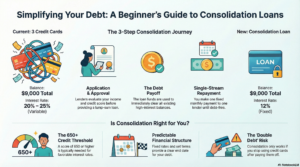
A debt consolidation loan is fundamentally a type of personal loan. The lender gives you a lump sum payment, which you use to pay off your existing debts. Once those debts are cleared, you’re left with only the consolidation loan to repay. Depending on your creditworthiness, you may secure a lower interest rate than what you were paying before — see how much you can save with real examples.
Here’s a simple breakdown of how it works:
- Application: You apply to a bank, credit union, or online lender. The lender looks at your income, bills, and credit score.
- Approval: If approved, the lender provides a lump sum loan. Some lenders pay your creditors directly, while others deposit funds into your account.
- Payoff: You use the loan profits to pay off your bills, including credit card balances and other high-interest loans.
- Repayment: You make a fixed monthly payment on the consolidation loan until it is fully repaid.
To illustrate, imagine you have three credit cards:
| Debt Type | Balance | Interest Rate | Monthly Payment |
| Credit Card A | $3,000 | 20% | $150 |
| Credit Card B | $4,000 | 22% | $200 |
| Credit Card C | $2,000 | 25% | $100 |
Total owed: $9,000 with varying high interest rates.
If you consolidate with a $9,000 personal loan at 12% interest over 4 years, your monthly payment may drop, and you’ll save money on interest compared to juggling three high-interest cards.
This arrangement gives you a precise timeframe for debt freedom and simplifies paying.
Key takeaway: Debt consolidation loans simplify repayment by combining multiple debts into one fixed-payment loan, often at a lower interest rate:
The Benefits and Drawbacks of Debt Consolidation
Debt consolidation loans can be appealing, but they’re not perfect for everyone. To make the right choice, it’s important to weigh the pros and cons carefully.
Benefits of Debt Consolidation Loans
- Simplified payments: Instead of multiple creditors and due dates, you’ll only manage one payment each month.
- Lower interest rates: You can get a cheaper rate than your current credit cards if your credit score is high, which lowers your total interest expenses.
- Predictable payments: Most debt consolidation loans come with fixed interest rates and set repayment terms, which means your payment stays the same until the loan is paid off.
- Potential credit score improvement: Paying off high-interest revolving debt like credit cards can reduce your credit utilization ratio, boosting your credit score — learn how to improve your credit score with debt consolidation.
- Emotional relief: Consolidation can reduce financial stress by providing a sense of structure and control.
Drawbacks of Debt Consolidation Loans
- Upfront costs: Some lenders charge origination fees, balance transfer fees, or prepayment penalties.
- Longer repayment terms: Lower monthly payments may seem attractive, but stretching repayment out for more years could increase the total interest you pay.
- Risk of new debt: If you don’t change spending habits, you may rack up new balances on cleared credit cards, worsening your financial situation.
- Credit requirements: Borrowers with poor credit may only qualify for high interest rates, reducing the benefit of consolidation.
Here’s a quick comparison:
| Factor | Benefit | Drawback |
| Monthly Payments | One simplified payment | Could last longer than the original debts |
| Interest Rates | Often lower than credit cards | Higher if the credit score is poor |
| Credit Score Impact | Can improve over time | A rigorous investigation could result in a brief decline. |
| Financial Discipline Needed | Encourages structured repayment | Risk of falling back into bad habits |
Key takeaway: Debt consolidation loans can save money and simplify finances, but success depends on disciplined repayment and avoiding new debt:
Who Should Consider a Debt Consolidation Loan?
Debt consolidation isn’t a one-size-fits-all solution. It works well for certain borrowers, but others may be better off exploring alternative debt relief strategies.
Ideal Candidates for Debt Consolidation Loans
- Borrowers with multiple high-interest debts, especially those struggling with credit card balances charging 18% to 25%.
- People with good to excellent credit scores: A score of 650 or higher can often qualify you for favorable rates.
- Individuals with steady income: Regular income ensures you can handle the monthly payments.
- Those seeking simplicity: Managing one loan is easier than tracking multiple accounts.
- Borrowers aiming to pay off debt faster: With a structured repayment plan, consolidation can accelerate progress.
Who Should Avoid Debt Consolidation Loans
- Unstable earners: If your income is irregular or at risk, taking on a consolidation loan could lead to missed payments.
- Borrowers with very low debt amounts: If you only owe a small balance, consolidation may not be worth the fees.
- Those with poor credit: High-interest consolidation loans may not improve your situation.
- Undisciplined spenders: If you continue using your credit cards after consolidating, you risk doubling your debt load.
Here’s a quick way to decide:
| Scenario | Best Approach |
| High credit card debt + good credit score | Debt consolidation loan |
| Small total debt, manageable payments | Direct repayment without consolidation |
| Poor credit, limited income | Explore a credit counseling or debt management plan. |
| Ongoing overspending habits | Focus on budgeting before consolidation. |
Key takeaway: Debt consolidation is best suited for financially stable borrowers with good credit who are committed to disciplined repayment.
The Complete Guide to Applying for a Debt Consolidation Loan
Although applying for a debt consolidation loan can seem daunting, the procedure is straightforward and organized. Being prepared can improve your chances of approval and help you secure the most favorable terms.
Step-by-Step Guide
- Check your credit report — unfamiliar with the terminology? See our complete glossary.
Review your credit score and history for errors. You can check your credit report for free at Experian. Lenders use this to decide eligibility and interest rates.
- Calculate your total debts.
Add up balances, interest rates, and monthly payments. Knowing the total loan amount you’ll need prevents under-borrowing.
- Compare lenders
Research banks, credit unions, and online lenders. Look at interest rates, repayment terms, fees, and customer reviews.
- Gather documentation
Prepare the following documents: income verification (pay stubs or tax returns), proof of employment, government-issued ID, and debt details.
- Submit your application
Apply in person. Expect a hard credit check, which may temporarily affect your credit score.
- Receive approval and loan funds.
If approved, you’ll either receive the money directly or the lender will pay your creditors on your behalf.
- Pay off existing debts.
Ensure all balances are cleared to avoid double payments or unexpected charges.
- Follow your repayment plan.
Make payments on time every month until the loan is repaid. Consider setting up autopay to avoid missed payments.
Pro Tips for a Successful Application
- Before committing, compare rates; even a tiny variation might result in hundreds of dollars in savings throughout the loan.
- Applying to too many lenders at once can have a negative effect on your credit score because of the numerous hard inquiries.
- Stay disciplined after consolidation by avoiding new high-interest debt.
Key takeaway: Applying for a debt consolidation loan is straightforward, but preparation and lender comparison are key to getting favorable terms:
Alternatives to Debt Consolidation Loans You Should Know
While debt consolidation loans are popular, they’re not always the best choice. Depending on your credit score, debt amount, and goals, alternatives may be more effective.
Common Alternatives
- Balance transfer credit cards: Ideal if you have good credit. Many offer 0% APR for 12–18 months, giving you time to pay down debt interest-free. However, they often charge balance transfer fees.
- Debt management plans (DMPs): Managed by credit counseling agencies, these plans consolidate payments through the agency, which negotiates lower interest rates with your creditors.
- Debt settlement involves negotiating a lower payment amount with creditors. While this reduces debt, it harms your credit score and may come with fees.
- Home equity loan or HELOC: Low interest rates are available if you own a property and can borrow against its equity. However, defaulting puts your home at risk.
- Bankruptcy: Bankruptcy is a last resort that can discharge some debts, but it has long-term detrimental effects on credit and financial stability.
Quick Comparison of Alternatives
| Option | Best For | Risks/Downsides |
| Balance transfer card | Good credit + small debts | High fees, high interest after intro |
| Debt management plan | Moderate debt + need for guidance | Monthly fees, long repayment timeline |
| Debt settlement | Severe financial hardship | Major credit score damage |
| Home equity loan/HELOC | Homeowners with strong equity | Risk of foreclosure if you default |
| Bankruptcy | Extreme unmanageable debt | Severe, lasting credit damage |
Key takeaway: Debt consolidation loans aren’t the only option — alternatives like balance transfers, debt management plans, or even bankruptcy may fit certain situations better:
Conclusion
Debt consolidation loans can be an effective way to lower interest costs, ease debt repayment, and lessen stress. However, they require financial discipline and careful consideration of alternatives. For beginners, the key is understanding how these loans work, who benefits most, and how to apply strategically. With the right approach, debt consolidation can be the first step toward financial freedom.
Preparing Your Finances Before You Apply
A point that many beginners underestimate is the importance of preparing your finances before applying for a debt consolidation loan. Even small adjustments—like reducing discretionary spending for 30 to 60 days—can improve your cash flow and lower your credit utilization. Both of these factors can strengthen your loan application and help you qualify for better terms. Lenders want to see that you are actively taking control of your financial situation, and demonstrating consistent, responsible behaviour can make a meaningful difference.
It is also helpful to review your existing debts in detail before choosing a consolidation strategy. Make a list of every balance, interest rate, minimum payment, and remaining term. This gives you a clear baseline for comparing consolidation offers. Many borrowers discover that some debts are better left out of consolidation—especially if they already carry low interest rates or are close to being paid off. Consolidation works best when it replaces high-interest, long-term debt with a more efficient structure.
Building Long-Term Financial Resilience
Another factor to consider is how consolidation affects your long-term financial resilience. A single monthly payment is easier to manage, but it is equally important to build a buffer so you do not rely on credit cards again. Setting aside even a small emergency fund—$25 to $50 per week—can prevent you from undoing the progress you have made. The goal is not just to simplify your debt, but to break the cycle that created it.
Borrowers should also pay close attention to lender transparency. Reputable lenders clearly disclose fees, APR ranges, prepayment policies, and hardship options. If a lender makes it difficult to find this information, uses pressure tactics, or promises “guaranteed approval,” that is a red flag. Debt consolidation is a legitimate financial tool, but the industry also attracts predatory companies. Taking time to compare lenders protects you from unnecessary costs and stress. For guidance on identifying trustworthy lenders, the Consumer Financial Protection Bureau is an excellent starting point.
How Consolidation Affects Your Credit Score Over Time
It is equally important to understand how consolidation interacts with your credit score over time. While your score may dip slightly when the loan is first opened—due to the hard inquiry and the new account reducing your average account age—consistent on-time payments typically lead to steady improvement. This is because consolidation reduces your credit utilization, adds positive payment history, and replaces multiple revolving accounts with a single installment loan. For many borrowers, this creates a healthier credit profile within six to twelve months. You can read more about this process in our guide on how debt consolidation can improve your credit score.
Consolidation Is a Tool, Not a Magic Fix
Finally, remember that consolidation is a tool—not a magic fix. The real transformation comes from the habits you build afterward. Tracking your spending, reviewing your budget monthly, and setting clear financial goals all reinforce the progress you have made. Many people find it helpful to schedule a quarterly “money check-in” to review their debt balance, savings, and credit score. These small routines help you stay on track and ensure that consolidation becomes a turning point rather than a temporary reset.
Preparing Your Finances Before You Apply
A point that many beginners underestimate is the importance of preparing your finances before applying for a debt consolidation loan. Even small adjustments—like reducing discretionary spending for 30 to 60 days—can improve your cash flow and lower your credit utilization. Both of these factors can strengthen your loan application and help you qualify for better terms. Lenders want to see that you are actively taking control of your financial situation, and demonstrating consistent, responsible behaviour can make a meaningful difference.
It is also helpful to review your existing debts in detail before choosing a consolidation strategy. Make a list of every balance, interest rate, minimum payment, and remaining term. This gives you a clear baseline for comparing consolidation offers. Many borrowers discover that some debts are better left out of consolidation—especially if they already carry low interest rates or are close to being paid off. Consolidation works best when it replaces high-interest, long-term debt with a more efficient structure. Our guide on how much debt consolidation can save you includes worked examples that can help you run these numbers before you apply.
Building Long-Term Financial Resilience
Another factor to consider is how consolidation affects your long-term financial resilience. A single monthly payment is easier to manage, but it is equally important to build a buffer so you do not rely on credit cards again. Setting aside even a small emergency fund—$25 to $50 per week—can prevent you from undoing the progress you have made. The goal is not just to simplify your debt, but to break the cycle that created it.
Borrowers should also pay close attention to lender transparency. Reputable lenders clearly disclose fees, APR ranges, prepayment policies, and hardship options. If a lender makes it difficult to find this information, uses pressure tactics, or promises “guaranteed approval,” that is a red flag. Debt consolidation is a legitimate financial tool, but the industry also attracts predatory companies. Taking time to compare lenders protects you from unnecessary costs and stress. For guidance on identifying trustworthy lenders, the Consumer Financial Protection Bureau is an excellent starting point.
How Consolidation Affects Your Credit Score Over Time
It is equally important to understand how consolidation interacts with your credit score over time. While your score may dip slightly when the loan is first opened—due to the hard inquiry and the new account reducing your average account age—consistent on-time payments typically lead to steady improvement. This is because consolidation reduces your credit utilization, adds positive payment history, and replaces multiple revolving accounts with a single installment loan. For many borrowers, this creates a healthier credit profile within six to twelve months. You can read more about this process in our guide on how debt consolidation can improve your credit score.
Consolidation Is a Tool, Not a Magic Fix
Finally, remember that consolidation is a tool—not a magic fix. The real transformation comes from the habits you build afterward. Tracking your spending, reviewing your budget monthly, and setting clear financial goals all reinforce the progress you have made. Many people find it helpful to schedule a quarterly “money check-in” to review their debt balance, savings, and credit score. These small routines help you stay on track and ensure that consolidation becomes a turning point rather than a temporary reset.
Frequently Asked Questions
What credit score do I need for a debt consolidation loan?
Although some accept lower scores with higher credit rates, most lenders prefer a score of 650 or higher.
Can debt consolidation loans hurt my credit?
Initially, a hard credit inquiry may cause a small dip, but on-time payments and lower credit utilization can improve your score long term.
Do debt consolidation loans eliminate debt?
No, they restructured it into one loan. You still owe the money, but under different terms.
How long does it take to pay off a debt consolidation loan?
Typically, 2 to 7 years, depending on your loan term and payment schedule.
Where can I learn more about my rights as a borrower?
The Consumer Financial Protection Bureau (CFPB) provides free resources on debt consolidation, your rights as a borrower, and how to avoid scams.
Are debt settlement and debt consolidation loans interchangeable?
No, settlement reduces the amount owed through negotiation, while consolidation combines debts into one loan.
Every debt situation is unique. If you’d like a one-on-one consultation with Bruce Creighton, CPA — with 35 years of financial experience — to review your specific debt consolidation options, contact us here.
How Much Can Debt Consolidation Save You? Real Examples


Debt can quickly snowball when it’s spread across credit cards, medical bills, and personal loans. Each balance comes with its own interest rate, fees, and due date, making repayment stressful and confusing. That’s where debt consolidation comes in. By combining all your debt into a single loan or program, you simplify repayment and often reduce interest costs. But how much can you really save with debt consolidation? Let’s dive into how debt consolidation works, look at real-world examples, crunch the numbers, and explore when consolidation makes sense. We will also answer the question: How Much Can Debt Consolidation Save You?
What Debt Consolidation Really Means (and How It Works)
Debt consolidation is often misunderstood as a form of debt forgiveness or settlement. In reality, it’s a financial strategy that combines multiple debts into one new loan—ideally at a lower interest rate or with better repayment terms. You only make one payment each month rather than balancing several payments to various lenders.
Understanding how much debt consolidation can save you is crucial for making informed financial decisions.
There are various ways to combine debt, and each has advantages and disadvantages.
- Personal loan consolidation – To pay off high-interest credit cards, many consumers take out personal loans from banks, credit unions, or online lenders. Personal loans usually have fixed interest rates and set repayment terms (e.g., 3–5 years).
- Balance transfer credit cards – These cards allow you to transfer existing balances onto one card, often with a 0% introductory APR for 12–18 months. This may be among the least expensive choices if you can settle the balance during the promotional time.
- Home equity loans and HELOCs – Homeowners may use the equity in their homes as collateral for a lower-rate loan or line of credit. Although this option has some of the lowest interest rates, defaulting could result in the loss of your house.
- Debt management plans – In order to reduce interest rates and fees, nonprofit credit counseling organizations might bargain with creditors. You make one monthly payment to the agency, which distributes it to your creditors.
Why It Works
Most credit cards charge interest rates of 18–29%. If you qualify for a personal loan at 9%, the interest savings can be dramatic. For example:
By asking yourself how much can debt consolidation save you, you can better appreciate the benefits of this financial strategy.
Understanding the answer to the question, How Much Can Debt Consolidation Save You, can help you make informed financial decisions and potentially save thousands over time.
So, how much can debt consolidation save you in the long run? Let’s explore some more examples.
| Total Debt | Current APR | Consolidation APR | Monthly Payment | Years to Pay Off | Interest Savings |
| $10,000 | 22% | 9% | $310 | 4 years | $5,200 |
The table shows how consolidating can reduce both the total interest paid and the repayment period, giving you a faster, more affordable path to debt freedom.
Key takeaway: Debt consolidation works by replacing multiple high-interest debts with a single, lower-interest payment, saving both money and stress:
Real-Life Savings: Case Studies of People Who Consolidated Debt
In real-life scenarios, knowing how much can debt consolidation save you is often revealed through case studies.
The best way to see debt consolidation’s benefits is through real-world stories. Many people across different financial situations have successfully saved thousands of dollars by consolidating debt.
Sarah’s Credit Card Debt
Sarah had $12,000 spread across three credit cards with an average APR of 22%. Her monthly minimums totaled about $360, and at that pace, it would have taken over 9 years to pay everything off, with more than $8,000 in interest.
She took out a 4-year personal loan at 9% APR. Her new monthly payment was $298, and she became debt-free in 4 years instead of 9. Her total savings: more than $6,000 in interest and 5 years of freedom gained.
Sarah realized that understanding how much can debt consolidation save you opened her eyes to new financial possibilities.
The Johnson Family’s Medical Bills
The Johnsons faced $18,500 in unpaid medical bills and a payday loan at 30% APR. Between high fees and stress, they couldn’t keep up. They used a $20,000 home equity loan at 6.5% APR over 5 years. Instead of drowning in late fees, they made one manageable payment, ultimately saving nearly $9,000 in interest.
The Johnsons were astonished when they discovered how much can debt consolidation save you in interest payments.
Mark’s Payday Loan Cycle
Mark had fallen into the payday loan trap. With a $5,000 payday loan carrying a 400% APR, he was paying $750 per month in rollover fees without reducing the principal. By consolidating with a credit union loan at 10% APR, his payment dropped to $106 per month. He escaped the cycle and saved thousands.
Mark’s experience also illustrates how much can debt consolidation save you when it comes to managing high-interest loans.
Why Case Studies Matter
These examples prove consolidation isn’t only about numbers—it’s about mental relief, reduced stress, and building confidence. The emotional savings can be as powerful as the financial ones.
These stories exemplify how much can debt consolidation save you, not just financially but emotionally as well.
Key takeaway: Real-world cases show debt consolidation can save thousands of dollars and years of repayment time, while providing peace of mind and financial stability:
The Math Behind the Savings: Breaking It Down Step by Step
Analyzing the math behind how much can debt consolidation save you is essential for making sound financial choices.
Understanding the actual math behind debt consolidation is key to making an informed decision. While lenders often promote “lower monthly payments” as the main benefit, the real advantage lies in reducing the total cost of borrowing. Let’s break it down step by step.
Step 1: Calculate Your Current Debt Costs
Calculating how much can debt consolidation save you requires understanding your current debt costs.
Suppose you have three credit cards totaling $ 5,000 in balances. Each carries a different interest rate, but the average APR works out to about 21%. If you only make the minimum payments (often around 2–3% of the balance), you could be in debt for 10 years or more. Over that period, you’d pay roughly $19,200 just in interest, not counting late fees or other charges.
Step 2: Compare with a Consolidation Loan
When comparing options, think about how much can debt consolidation save you over time.
Now imagine you consolidate that $15,000 into a personal loan at 9% APR for a 5-year term. Your monthly payment becomes $311, and by the end of 5 years, you’ll have paid only $3,600 in interest. The savings are dramatic: more than $15,000 less in interest and half the repayment time.
Here’s a side-by-side comparison:
| Scenario | Total Debt | APR | Years to Pay Off | Monthly Payment | Total Interest |
| Without Consolidation | $15,000 | 21% | 10 | $430 | $19,200 |
| With Consolidation | $15,000 | 9% | 5 | $311 | $3,600 |
Step 3: Consider Additional Variables
While the numbers look good, it’s important to consider fees. Some personal loans carry origination fees of 2–8% of the loan amount. If your $15,000 loan has a 5% fee, that’s $750 upfront. While you’d still save significantly, the reduced fee decreases your net benefit. Similarly, balance transfer credit cards usually charge a 3–5% transfer fee, so moving a $10,000 balance could cost $300–$500.
Step 4: Factor in Behavioral Savings
Numbers aside, consolidation saves money in indirect ways too. By having one fixed monthly payment, you’re less likely to miss due dates, avoiding late fees (which average $25–$40 each time). Consolidation also prevents the “minimum payment trap,” where you pay for years without making real progress on your balance.
Step 5: Long-Term Impact
Lower interest and structured payments mean more of your money goes toward principal, helping you build momentum. Imagine redirecting the $15,600 you saved in interest into an emergency fund or retirement account—that’s long-term wealth-building.
Finally, consider how much can debt consolidation save you as you plan for your financial future.
Key takeaway: The math behind debt consolidation shows that lower APRs and structured payments save thousands in interest and cut repayment time in half, provided you account for fees and stay disciplined:
When Debt Consolidation Saves You Money (and When It Doesn’t)
Understanding the benefits helps answer the question: how much can debt consolidation save you in various situations?
Debt consolidation is powerful, but it’s not always he right solution. To make it work in your favor, you need to understand when it provides real benefits—and when it could actually cost more.
When Consolidation Works Best
Debt consolidation can indeed show you how much can debt consolidation save you, especially when done strategically.
- High-interest debt: Switching to a loan with single-digit interest rates can save you thousands of dollars if the majority of your debt is from credit cards with 18–29% APR.
- Good to excellent credit: With a strong credit score, you can qualify for favorable rates (sometimes under 7%), maximizing savings.
- Steady income: If you can make consistent monthly payments, consolidation provides a clear payoff path.
- Debt discipline: Consolidation works if you stop using credit cards and avoid building new debt during repayment.
When Consolidation May Not Help
-
- High loan fees, such as origination fees (3–8%), balance transfer charges, or service costs, may cancel out the benefits.
To maximize benefits, start by asking how much can debt consolidation save you based on your current financial habits.
- Extended loan terms: Stretching repayment over 10 years instead of 5 reduces your monthly payment, but it may also increase your total interest paid.
- Low credit score: If you only qualify for consolidation loans with rates close to your existing ones (say 15–20%), the savings won’t be significant.
- Poor financial habits: If you continue using credit cards after consolidating, you could double your debt load.
Common Pitfalls to Avoid
- Chasing lower payments only: A smaller monthly bill may feel easier, but if the term doubles, you’re spending more overall.
- Not addressing spending habits: Without budgeting, consolidation only provides temporary relief.
- Choosing the wrong product: A home equity loan may offer a low rate, but it puts your home at risk if you default.
Who Should Avoid Consolidation
- Those with very small balances (under $1,000) where fees outweigh benefits.
- Anyone without a stable income to make the payments.
- Borrowers who know they’ll be tempted to use credit cards again after paying them off.
Key takeaway: Debt consolidation saves money when used strategically, but fees, extended terms, and poor discipline can erase the benefits or even make debt worse:
Ultimately, knowing how much can debt consolidation save you is key to making informed choices about your finances.
Tips to Maximize Your Savings After Consolidating
Consolidating debt is only the first step. To truly maximize savings, you need to approach repayment with strategy and discipline.
Choose the Best Option for Your Situation
- Personal loans Are Best Suited for individuals with decent credit and fixed repayment goals.
- Balance transfer credit cards: Ideal if you can pay off the debt within the 0% APR promotional period.
- Home equity loans/HELOCs: Effective for large debts, but risky if you can’t repay.
- For those who require a structured repayment plan but are not eligible for loans, debt management plans are perfect.
Avoid Fees and Hidden Costs
- Shop around and compare lenders—small differences in APR add up.
- Look for loans without prepayment penalties so you can pay early without fees.
- Read the fine print carefully to avoid surprises.
Build Habits That Prevent Relapse
- Automate payments: This ensures you never miss a due date, protecting your credit.
- Stop using credit cards: Put them away or keep just one for emergencies.
- Track progress visually: Watching balances decrease keeps you motivated.
- Create an emergency fund: This prevents you from relying on credit again.
- Budget consistently: Use apps or spreadsheets to stay on top of your finances.
Use Savings to Build Wealth
Consolidation can free up hundreds of dollars each month. Instead of letting that money slip away, channel it toward long-term goals:
- Build a 3–6 month emergency fund.
- Pay down other obligations like student loans or car payments.
- Start investing for retirement.
Psychological Benefits
Beyond money, consolidation provides peace of mind. Knowing you have one clear payment date and a timeline for becoming debt-free reduces stress and increases confidence. This mental relief is often just as valuable as the financial savings.
Key takeaway: To maximize debt consolidation savings, choose the right product, avoid fees, commit to no new debt, and redirect freed-up cash toward long-term financial stability:
Conclusion
In conclusion, reflecting on how much can debt consolidation save you is essential for financial empowerment.
Debt consolidation can transform unmanageable debt into a structured repayment plan, saving thousands in interest and years of stress. The key is choosing the right option, running the math carefully, and staying committed. For many, it’s not only a money-saver but also a chance to build lasting financial security.
FAQs
Lastly, FAQs often highlight how much can debt consolidation save you and its impact on credit scores.
Does debt consolidation hurt your credit score (see our guide on how debt consolidation can improve your credit score)?
It may cause a temporary dip, but on-time payments usually improve your score over time.
Can I consolidate with bad credit?
Yes, though options are limited. Credit unions or nonprofit debt programs may still help.
What’s better—debt consolidation or debt settlement?
Consolidation helps you pay in full at a lower interest rate. Settlement reduces balances but damages credit significantly.
Is debt consolidation the same as refinancing?
Not exactly. Refinancing replaces one loan with another, while consolidation combines multiple debts into one.
How fast will I be debt-free with consolidation?
It depends on your plan, but most people save 3–5 years compared to making minimum payments.
For many, the question remains: how much can debt consolidation save you on your journey to financial freedom?
Home Equity Loans for Debt Consolidation: Benefits and Risks

Managing multiple high-interest debts can feel overwhelming, especially when minimum payments barely chip away at balances. For homeowners, one solution often considered is a home equity loan (a type of debt consolidation loan)—a way to borrow against the value of your home to consolidate debts into one fixed monthly payment. While this strategy can reduce interest costs and simplify finances, it also comes with serious risks. In this article, we’ll explore the benefits, drawbacks, comparisons, and decision-making factors surrounding home equity loans for debt consolidation.
What Is a Home Equity Loan and How Does It Work?
A home equity loan is a type of secured loan that enables homeowners to borrow against the equity they have accrued in their home. Equity is the amount that separates your home’s current market value from the remaining mortgage balance. For example, if you still owe $200,000 on your mortgage and your house is worth $300,000, you have $100,000 in equity.
Lenders usually permit you to borrow 80 to 85 percent of such equity, though terms may differ. This makes a home equity loan a popular choice for large expenses, such as debt consolidation, home improvements, or medical bills.
How Home Equity Loans Work
- Application Process: A credit check, financial papers, and sometimes an appraisal of your house are all required.
- Loan Disbursement: Approved borrowers receive a lump sum upfront. This makes it different from a Home Equity Line of Credit (HELOC), which functions more like a revolving credit line.
- Fixed Terms: Home equity loans typically feature fixed interest rates, repayment schedules ranging from 5 to 30 years, and predictable monthly payments.
- Repayment: Payments consist of both principal and interest, structured to fully pay off the loan by the end of the term.
Common Uses for Home Equity Loans
- Debt Consolidation: Rolling multiple high-interest debts into one lower-interest loan.
- Home Renovations: Using funds for projects that may increase property value.
- Education Costs: Covering tuition or other education-related expenses.
- Emergency Expenses: Handling unexpected financial needs without high-interest credit.
Example
Suppose you have $40,000 in credit card debt spread across five accounts with average rates of 20%. By taking a $40,000 home equity loan at 7% interest over 10 years, you could replace multiple unpredictable payments with one fixed monthly payment—saving potentially thousands in interest.
Key takeaway: A home equity loan is essentially a way to leverage the value of your home to access funds at lower interest rates, often making it attractive for consolidating debt:
The Main Advantages of Consolidation
ng Debt with Home Equity Loans
The financial benefit of combining high-interest debt into a single, lower-interest loan is one of the main reasons people use home equity loans. When used responsibly, these loans can provide significant relief.
Main Benefits
- Lower Interest Rates: Since your property secures the loan, lenders view it as less risky, often resulting in much lower rates than credit cards or personal loans.
- Fixed Repayment Plan: Unlike credit cards with fluctuating balances, a home equity loan provides stability with fixed monthly payments. This predictability helps in budgeting and planning long-term.
- Debt Simplification: Instead of tracking multiple payments across different lenders, you only have one payment to worry about. This reduces stress and decreases the likelihood of missing due dates.
- Higher Borrowing Limits: Home equity loans typically offer greater loan amounts than unsecured personal loans, which makes them appropriate for borrowers with significant debt.
- Potential Tax Advantages: Interest paid on a home equity loan may occasionally be tax-deductible, though this usually only applies if the money is spent for upgrades to the house. Always consult a tax professional before relying on this benefit.
Example Scenario
Imagine a borrower juggling four credit cards totaling $25,000 in debt, each with an interest rate of 18–22%. The combined monthly payments exceed $700, with most going toward interest. By consolidating into a $25,000 home equity loan at 6% over 10 years, their monthly payment might drop to around $280, with a much larger portion applied to principal. This accelerates debt payoff and frees up cash flow.
Long-Term Financial Benefits
- Reduced stress from financial complexity.
- A clearer path toward debt freedom.
- Lower monthly obligations, freeing funds for savings or investments.
However, these benefits rely heavily on financial discipline. Without it, borrowers may pay off old debts only to create new ones, leading to a cycle of borrowing.
Key takeaway: The main advantages of home equity loans are lower rates, higher loan limits, and simplified repayment, but they only work if borrowers avoid accumulating new debt:
The Hidden Risks and Potential Downsides You Need to Know
Although home equity loans offer appealing benefits, they also come with serious drawbacks that can outweigh the advantages if not carefully considered.
Major Risks
- Foreclosure Risk: Your home serves as collateral. If you default on the loan, the lender has the right to foreclose, putting your property at risk.
- Closing Costs and Fees: Like a traditional mortgage, these loans often carry upfront costs ranging from 2–5% of the loan amount. For a $40,000 loan, that’s $800 to $2,000 in fees.
- Longer Repayment Terms: Deferring debt for decades may result in reduced monthly payments, but the overall amount of interest paid may rise dramatically.
- Negative Equity Potential: Taking out large loans reduces the equity in your home, which could be problematic if housing values decline.
- Temptation to Overspend: Some borrowers feel “freed” after consolidating debt and begin racking up new balances, creating a bigger financial burden.
Example Scenario
A homeowner consolidates $50,000 in debt with a 20-year home equity loan at 6%. While the monthly payments may be affordable, the total repayment over two decades could exceed $86,000, including interest. Compare this to paying off the debt in 5 years with higher monthly payments—although more challenging, the shorter payoff would save tens of thousands in interest.
Situations Where Risks Are Higher
- Unstable income or job uncertainty.
- Low home equity that limits flexibility.
- Borrowers with poor spending habits risk accumulating more debt.
Key takeaway: The risks of home equity loans include foreclosure, costly fees, and the danger of increasing debt if spending habits don’t change:
Comparing Home Equity Loans with Other Debt Consolidation Options
Home equity loans are just one option among several debt consolidation tools. Before deciding, it’s important to weigh them against alternatives.
Comparison Table
| Option | Interest Rates | Repayment Terms | Collateral Required | Best For |
| Home Equity Loan | 5–9% (fixed) | 5–30 years | Yes (home) | Homeowners with equity and stable income |
| Personal Loan | 7–15% (fixed/variable) | 2–7 years | No | Borrowers with good credit and moderate debt |
| Balance Transfer Credit Card | 0–5% (intro APR) | 12–18 months | No | Small to medium debt with disciplined payoff |
| Debt Management Plan | Varies | 3–5 years | No | Borrowers seeking professional guidance |
| HELOC (Home Equity Line of Credit) | Variable, 6–10% | Flexible | Yes (home) | Borrowers needing flexible access to funds |
Key Observations
- Home equity loans are best suited for large amounts of debt with stable repayment ability.
- Personal loans work well for smaller debts and shorter repayment horizons.
- Balance transfers can save significantly if you repay debt within the promotional period, but high penalty rates apply if balances remain afterward.
- Debt management plans provide structure but may impact your credit report.
- HELOCs are more flexible but come with variable interest rates, which can make payments unpredictable.
Key takeaway: While home equity loans offer stability and lower rates, alternatives such as personal loans or balance transfers may be safer for those unwilling to risk their home.
Is a Home Equity Loan Right for You? Key Factors to Consider Before Deciding
It’s crucial to carefully consider your financial circumstances before choosing to use a home equity loan for debt consolidation.
Questions to Ask Yourself
- Do I have at least 15–20% equity in my home to qualify?
- Is my income steady enough to handle long-term payments?
- Am I confident I won’t accumulate new debt after consolidation?
- Would a shorter-term loan (like a personal loan) be safer?
- How long do I plan to stay in my home? Borrowing against equity may reduce your profit if you sell soon.
Who Should Consider It
- Homeowners with stable jobs and reliable income.
- Those with large amounts of high-interest debt.
- Borrowers are disciplined enough to avoid new credit card debt after consolidation.
Who Should Avoid It
- People with unstable income or uncertain employment.
- Homeowners who plan to sell in the near future.
- Borrowers with poor credit or low equity.
Alternatives to Explore First
- Negotiate lower rates with creditors.
- Explore personal loans with shorter repayment terms.
- Try a balance transfer card for smaller amounts of debt.
- Work with a credit counseling agency for structured debt management.
Key takeaway: If you have substantial equity, steady income, and the self-control to resist taking on more debt, a home equity loan might be the best option. However, it’s not appropriate for everyone.
Conclusion
Home equity loans can provide a lifeline for homeowners drowning in high-interest debt. With lower rates, fixed payments, and higher borrowing limits, they offer clear advantages for debt consolidation. But the risks—particularly the threat of foreclosure—are significant. The key is to weigh benefits against downsides, compare alternatives, and honestly assess your financial habits before committing.
Frequently Asked Questions (FAQs)
Is it smart to use a home equity loan for credit card debt?
Securing a lower interest rate and avoiding new debt can be smart, but it carries foreclosure risk.
What credit score (see: How Debt Consolidation Can Improve Your Credit Score) is needed for a home equity loan?
Most lenders require a credit score of at least 620–680, while individuals with scores above 700 are eligible for better rates.
Can I lose my home with a home equity loan?
Yes. Since your home is collateral, missed payments could result in foreclosure.
What is the maximum amount I can borrow using a home equity loan?
Typically, up to 80–85% of your home’s value minus your existing mortgage balance.
What’s the difference between a home equity loan and a HELOC?
A HELOC functions similarly to a revolving line of credit with variable rates, whereas a home equity loan offers a flat payment with set terms.
If you believe a lender has acted improperly or violated your rights during the home equity loan process, you have the right to submit a formal complaint to the Consumer Financial Protection Bureau (CFPB). The CFPB investigates complaints against mortgage lenders and can take enforcement action where warranted.
Top 10 Mistakes to Avoid When Consolidating Debt

Debt consolidation is often marketed as a smart financial move for people juggling multiple loans or credit cards. At its core, it simplifies payments by rolling them into one monthly bill, ideally with a lower interest rate. But while consolidation can help you breathe easier, many borrowers make avoidable mistakes that end up costing more in the long run.
This article explores the top 10 mistakes people make when consolidating debt, why they matter, and how to avoid them.
Affiliate & Editorial Disclosure: The Money Question may earn a commission if you click through certain links on this page and are approved for a financial product. This does not influence our editorial content or rankings. We are committed to providing accurate, unbiased information to help you make informed financial decisions. For full details, please review our Affiliate Disclosure Policy.
Ignoring the True Cost of Debt Consolidation
When people think of debt consolidation, they often focus on the most immediate benefit: lowering their monthly payment. And while it’s true that combining debts into one loan can reduce financial pressure, it’s a mistake to focus only on the monthly figure.
Many consolidation loans extend the repayment period. For example, if you were paying $500 across multiple credit cards and now you’re paying $300 through a consolidated loan, you may feel more financially stable. However, if your repayment timeline stretches from three years to seven, the total interest you pay over time could be much higher.
Why the true cost matters
- Extended terms = more interest: Even with a lower rate, a longer term increases total costs.
- False sense of relief: Lower monthly payments may feel like progress, but the overall debt burden may grow.
- Misleading offers: Some lenders highlight “affordable” payments without explaining total costs.
How to calculate your real costs
- Use our free Debt Consolidation Savings Calculator to compare total repayment amounts.
- Request an amortization schedule from your lenders that breaks down the percentage of each payment that goes toward principal vs interest.
- Compare consolidation with your current repayment plan side by side.
For instance:
|
Scenario |
Monthly Payment |
Loan Term |
Total Interest Paid |
|
Current Debts |
$500 |
3 years |
$3,000 |
|
Consolidated Loan |
$300 |
7 years |
$6,800 |
This shows how deceptive a lower monthly payment can be without context.
Key takeaway: Don’t be fooled by smaller monthly payments—calculate the total cost to understand the real impact of consolidation.
Overlooking Hidden fees
Another costly mistake borrowers make is failing to account for the hidden costs that come with consolidation. While lenders promote the simplicity of a single monthly payment, many loans and balance transfers come with fees that can eat into or eliminate your savings.
Common hidden costs
- Balance transfer fees: Credit cards that offer 0% APR for balance transfers typically charge 3–5% of the transferred balance upfront.
- Origination fees: Personal loans often include fees ranging from 1% to 8% of the loan amount.
- Prepayment penalties: Some lenders charge you for paying the loan off early.
- Late fees: Penalties for late payments might be severe and may reset promotional rates.
Why fees matter
You will immediately incur $400 in fees if you move $10,000 in credit card debt to a balance transfer card that has a 4% fee. That’s before you’ve even started paying down the balance. Similarly, a $20,000 personal loan with a 6% origination fee would cost $1,200 upfront.
How to avoid this mistake
- Request full disclosure: Always ask the lender to explain every potential fee in writing.
- Compare APR, not just interest rate: APR includes fees, making it a more accurate measure of cost.
- Read fine print carefully: Many surprises hide in the terms and conditions.
Key takeaway: Don’t ignore hidden fees—calculate their impact before deciding if consolidation really saves you money.
Not Checking Your Credit Score Before Applying
One of the main determinants of whether consolidation will benefit or harm you is your credit score. Yet many people rush into applying without knowing their score, only to face rejection or high interest rates that negate the purpose of consolidating in the first place. Our Annual Credit Report Guide shows you how to access your free report.
Why your score matters
- Approval chances: Many consolidation options require a fair-to-good credit score.
- Interest rate eligibility: A higher score typically means a lower interest rate.
- Potential harm: Multiple rejected applications can lead to repeated hard inquiries, further lowering your score.
Steps to take before applying
- Get your credit report at AnnualCreditReport.com.
- Review your score through free monitoring services or your bank.
- Correct any errors or dispute inaccurate information.
- Consider improving your score first if it’s below 650 by paying down existing debts and avoiding new credit applications.
Example: Impact of score on loan offers
|
Credit Score |
Estimated Interest Rate |
Loan Amount |
Monthly Payment (5 yrs) |
|
750+ (Excellent) |
7% |
$10,000 |
$198 |
|
650 (Fair) |
15% |
$10,000 |
$238 |
|
580 (Poor) |
25% |
$10,000 |
$294 |
As the table shows, a higher score not only saves you on interest but also lowers monthly costs significantly.
Key takeaway: Always know your credit score before applying for consolidation—it can make or break the deal.
Consolidating Without Fixing Spending Habits
One of the most common traps people fall into when consolidating debt is assuming the loan itself will solve their financial problems. While consolidation can simplify payments and sometimes reduce interest rates, it doesn’t address the root cause of debt: overspending or poor money management. You run the risk of accruing more debt on top of the consolidation loan if you don’t alter your behavior.
Why spending habits matter
- Debt cycle danger: Without new habits, people often pay off their credit cards with a loan, then start using the cards again.
- Psychological relief: A consolidated loan can create a false sense of accomplishment that leads to complacency.
- Debt pile-up: Combining old debts into a loan while racking up new ones leads to an even bigger financial mess.
How to break the cycle
- Create a budget: Use programs like Mint or YNAB (You Need a Budget) to keep track of your earnings and outlays.
- Use cash or debit: Avoid relying on credit cards to cover shortfalls.
- Identify spending triggers: Emotional shopping, lifestyle inflation, or lack of planning often fuel debt.
- Build an emergency fund: Even a small savings buffer prevents unexpected costs from being charged to credit cards.
Practical example
Imagine you consolidate $15,000 of credit card debt into a personal loan. You feel relieved and start spending on credit cards again. Within two years, you now owe $10,000 on cards plus $15,000 on the loan—a worse situation than before.
By contrast, if you had created a budget, avoided new credit card use, and built an emergency fund, you’d be steadily paying down the consolidation loan and moving toward financial freedom.
Key takeaway: Debt consolidation works only if you pair it with healthier spending habits—otherwise, you risk doubling your debt.
Choosing the Wrong Type of Consolidation Loan
Not all debt consolidation strategies are created equal. One of the biggest mistakes borrowers make is selecting a loan or program that doesn’t align with their financial situation. The wrong choice can leave you with higher risks, greater costs, or even less flexibility. Compare your options on our Best Debt Consolidation Loans of 2026 page.
Common types of consolidation loans
- If you can pay off high-interest credit card debt in 12 to 18 months, balance transfer credit cards are a great option. However, they usually come with transfer fees and require good credit to qualify.
- Personal loans: Fixed interest and predictable payments make them popular, but rates vary based on your credit score.
- Home equity loans/HELOCs: These often have lower rates but use your house as collateral, risking foreclosure if you default.
- Debt management plans (through nonprofits): Structured repayment with lower interest, but requires working with a credit counseling agency.
Risks of choosing poorly
- Using secured debt for unsecured balances: Turning credit card debt into home equity debt puts your property at risk.
- Not accounting for payoff ability: A balance transfer card is risky if you can’t pay it off before the promo period ends.
- Misunderstanding loan terms: Variable rates may start low but increase later, raising costs.
How to choose the right option
- Evaluate your repayment timeline (short-term vs. long-term).
- Consider your tolerance for risk (secured vs. unsecured loans).
- Compare APRs, not just rates.
- Match the method to your goals—fast payoff, predictability, or lowest possible rate.
Key takeaway: Choose a consolidation method that fits your needs—selecting the wrong one can increase risks and costs.
Falling for Debt Relief Scams
Desperation makes borrowers vulnerable to scams, and the debt relief industry is unfortunately full of them. Fraudulent companies promise quick fixes, “instant debt forgiveness,” or “government programs” that don’t exist. Many charge hefty upfront fees without ever delivering results. Read our full guide: How to Spot Debt Consolidation Scams Before It’s Too Late.
Common scam tactics
- Upfront fees: Legitimate credit counselors (find one through the National Foundation for Credit Counseling) won’t demand large payments before helping you.
- Guarantees: No company can promise to “erase” your debt overnight.
- Pressure tactics: Scammers often push you to sign immediately.
- Fake government programs: Fraudsters use official-sounding names to appear credible.
How to protect yourself
- Research companies on the Better Business Bureau.
- Look for nonprofit credit counseling agencies accredited by the National Foundation for Credit Counseling.
- Check the Federal Trade Commission’s debt relief guidance.
- Never give personal information or payment details over the phone without verifying legitimacy.
Real-life example
A borrower in debt may see an ad claiming “cut your debt by 70% instantly.” They pay $1,000 upfront, only to discover the company does nothing—or worse, instructs them to stop paying creditors, leading to late fees and lawsuits.
Key takeaway: Stay vigilant—if a company promises instant results or charges upfront fees, it’s likely a scam.
Closing Old Accounts Too Soon
After consolidating, many people close their old credit card accounts to avoid temptation. While this may feel like a clean break, it can actually hurt your credit score.
Why keeping accounts matters
- Credit utilization ratio: This measures how much credit you’re using compared to what’s available. Closing cards reduces available credit, increasing utilization and lowering your score.
- Length of credit history: Old accounts help establish a longer credit history, a key factor in your score.
- Score mix: Having different types of credit (cards, loans) strengthens your profile.
Better alternatives
- Keep accounts open but avoid using them.
- Set up small recurring payments (like subscriptions) and pay them off immediately to keep the account active.
- Cut up physical cards if temptation is an issue, while leaving accounts open.
Example
If you consolidate $8,000 of credit card debt and then close the accounts, your available credit may drop from $15,000 to $5,000. Even if you owe nothing, your utilization ratio spikes if you later use a small amount of credit, hurting your score.
Key takeaway: Don’t close accounts right away—keeping them open can boost your credit score long term.
Extending Loan Terms Just for Lower Payments
It’s tempting to stretch out your consolidation loan over the longest period possible to minimize monthly payments. While this helps short-term affordability, it can add years to repayment and thousands in interest costs.
Why are long-termcosts more
- Interest accumulation: More months mean more interest charges.
- False affordability: A smaller payment doesn’t mean a cheaper loan.
- Debt fatigue: Staying in debt for a decade or more can reduce motivation to stay disciplined.
Example comparison
|
Loan Amount |
Rate |
Term |
Monthly Payment |
Total Interest |
|
$20,000 |
8% |
5 years |
$405 |
$4,300 |
|
$20,000 |
8% |
10 years |
$242 |
$9,000 |
The longer loan feels easier, but costs twice the interest.
When longer terms make sense
- If your budget is extremely tight.
- If you plan to make extra payments anyway (and the loan has no prepayment penalties).
Key takeaway: Don’t automatically choose the longest loan term—lower payments often mean much higher costs over time.
Not Comparing Multiple Lenders and Offers
Another mistake is accepting the first consolidation offer without comparing it to other options. Interest rates, fees, and repayment terms vary widely between lenders, so failing to shop around could cost thousands. Start with our Best Debt Consolidation Loans of 2026 comparison.
Why comparison matters
- Wide rate differences: One lender might offer 8%, while another charges 15% for the same loan.
- Fees vary: Origination and transfer fees can differ significantly.
- Hidden terms: Some lenders may include prepayment penalties or variable rates.
How to shop effectively
- Use loan comparison websites to see multiple offers.
- Focus on APR, which includes interest and fees.
- Read customer reviews to check the lender’s reputation.
- Apply for prequalification where possible, which uses a soft credit pull.
Example scenario
Borrower A accepts the first offer at 14% interest on a $15,000 loan. Borrower B shops around and secures a loan at 9%. Over five years, Borrower B saves nearly $4,000 in interest compared to Borrower A.
Key takeaway: Always compare multiple offers—shopping around can save you thousands.
Skipping Professional Guidance When Needed
Many borrowers attempt to manage debt consolidation on their own, but in complex situations, skipping professional help can backfire. Debt can be overwhelming, and making the wrong choice could cost more than asking for guidance. If you are just starting out, our Beginner’s Guide to How Debt Consolidation Loans Work is a great place to start.
When to seek help
- You have multiple types of debt (credit cards, medical bills, business loans).
- You’re considering bankruptcy as a last resort.
- You don’t understand loan terms or the impacts on your credit.
- You’re struggling emotionally with financial stress.
Who to turn to
- Nonprofit credit counselors: Certified professionals who can help you budget, negotiate with creditors, and enroll in debt management plans.
- Financial advisors: Experts who can evaluate how consolidation fits into your long-term financial goals.
- Legal professionals: Bankruptcy attorneys can provide advice if consolidation isn’t viable.
Benefits of professional advice
- Avoiding scams.
- Choosing the best debt solution for your circumstances.
- Peace of mind knowing you’re on the right track.
Key takeaway: If your situation is complex, professional help can prevent costly mistakes and give you clarity.
Conclusion
Debt consolidation can simplify repayment and reduce interest costs, but only if handled carefully. By avoiding these common mistakes, you’ll increase your chances of not just consolidating debt but actually becoming debt-free. Remember, consolidation is only part of the journey—the real progress comes from building healthier money habits. Unfamiliar with any terms? Our Complete Debt Consolidation Glossary has you covered.
FAQs
Will debt consolidation hurt my credit score?
It may cause a small dip at first, but over time, responsible repayment can improve your score.
What distinguishes debt settlement from debt consolidation
Consolidation combines debts into one payment. Settlement involves paying less than owed, which can often damage credit.
Can I consolidate debt with bad credit?
Yes, however, prices might be higher, and alternatives might be more limited. A secured loan or co-signer could be beneficial.
How long does debt consolidation stay on my credit report?
The loan appears as a new account, but a positive repayment history strengthens your credit over time.
Is debt consolidation always the best choice?
Not always. If you can manage payments individually, consolidation may not be necessary. It’s ideal for individuals struggling with multiple payments.