Minimum Wage Increases: Do They Create Jobs or Cause Unemployment?
AFFILIATE DISCLOSURE: This site does not currently have affiliate partnerships. All content is independently researched and written to provide you with accurate, unbiased financial information.
The debate over the minimum wage is one of the most enduring and fiercely contested in economics. On one side, advocates argue that raising the wage floor is a moral imperative that lifts families out of poverty and stimulates the economy by putting money into the hands of people who spend it immediately. On the other side, critics warn that artificially inflating the cost of labor forces businesses to cut hours, lay off workers, or accelerate the shift to automation.
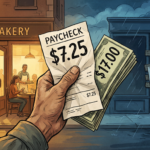
As we move through 2026, the landscape of the minimum wage in the United States is more fragmented than ever. The federal minimum wage remains frozen at $7.25 an hour — where it has sat since 2009, the longest period without an increase in U.S. history. Meanwhile, states and cities have taken matters into their own hands, pushing local minimums to $15, $17, $19, and higher.
In 2026, 88 jurisdictions across the U.S. will raise their minimum wage floors, with dozens surpassing $17.00 an hour. National Employment Law Project So what does the data actually show? When the minimum wage goes up, do workers win — or do jobs disappear?
The Frozen Federal Wage: A Shrinking Floor
Before examining the debate, it is essential to understand the baseline. The federal minimum wage of $7.25 an hour has not increased since July 2009. A full-time worker at that rate earns approximately $15,080 per year — well below the federal poverty line for a family of two, and a fraction of what a living wage calculator shows is needed in most U.S. cities.
Inflation has significantly eroded the buying power of the federal minimum wage since 2009. Stateline In real terms, the federal minimum wage is worth less today than at almost any point in the past 60 years. The $7.25 of 2009 would need to be approximately $10.50 today just to match the same purchasing power — meaning the real minimum wage has been quietly falling for 17 years without a single vote.
The minimum wage remains stagnant at $7.25 in 20 states — primarily conservative-led states including Alabama, Iowa, Texas, and Wyoming — while the policy divergence between those states and high-wage jurisdictions like California and Washington widens every year.
The Case For Raising the Minimum Wage
1. Direct Poverty Reduction
A higher wage floor directly increases take-home pay for the lowest earners, helping them afford basic necessities. The Economic Policy Institute estimates that raising the federal minimum wage to $17 by 2030 would impact 22.2 million workers — 15% of the U.S. workforce — providing an additional $70 billion annually in wages. Economic Policy Institute
2. The Economic Multiplier Effect
Low-wage workers have a high “marginal propensity to consume” — they spend almost every additional dollar they earn on immediate needs. When minimum wage workers receive a raise, that money flows directly back into local economies through spending on groceries, rent, utilities, and services. This increased consumer demand can stimulate local growth and, in theory, create new jobs to meet it.
3. Reduced Employee Turnover
Higher wages lead to higher job satisfaction and loyalty. Replacing an employee is expensive — involving recruitment, training, and lost productivity. Research finds that minimum wage hikes lead to reduced labor market turnover and reduced separations, suggesting minimal net employment effects from the perspective of frictional labor markets. ScienceDirect Businesses that pay more retain experienced staff, improve productivity, and reduce the hidden costs of constant churn.
4. Broader Social Benefits
Research increasingly finds that higher wages improve educational outcomes, mental and physical health — benefits that extend beyond workers themselves to communities and society as a whole. Children in households that benefit from minimum wage increases show measurable improvements in school attendance, academic performance, and long-term earnings.
5. Correcting Monopsony Power
A newer and increasingly influential strand of economics research argues that many low-wage labor markets are dominated by a small number of large employers — giving those employers “monopsony power” to pay workers less than their true economic contribution. Research from the University of Pennsylvania provides compelling evidence that in highly concentrated markets, minimum wage increases can actually improve employment outcomes. UPenn SP2
The Case Against Raising the Minimum Wage
1. Job Losses and Reduced Hours
Businesses operating on thin margins — restaurants, small retailers, care providers — may be unable to absorb sudden labor cost increases. To survive, they may lay off workers, halt new hiring, or cut hours. The workers who keep their jobs benefit; those who lose them do not. This is the core concern with large, rapid, uniform increases.
2. The Automation Accelerant
As the cost of human labor rises, the financial incentive to replace workers with technology increases. Self-checkout kiosks, automated ordering screens, AI-driven customer service, and warehouse robotics are already displacing entry-level jobs. A higher minimum wage can accelerate this shift in ways that are difficult to reverse — permanently eliminating the lowest rungs on the career ladder.
3. Price Inflation in Low-Margin Industries
If businesses cannot cut staff or automate, they pass increased labor costs to consumers through higher prices. Research suggests restaurants absorb minimum wage increases primarily through slight price increases rather than mass layoffs — but those price increases fall disproportionately on lower-income consumers who spend a larger share of their budgets on food.
4. Rural and Regional Harm From Uniform Mandates
A $15 minimum wage is readily absorbed by businesses in Seattle or New York City, where median wages and costs of living are high. The same mandate could devastate small businesses in rural Mississippi or Alabama, where the economic context is fundamentally different. A one-size-fits-all national mandate ignores these geographic realities in ways that can cause real harm to low-cost economies.
What the Evidence Actually Shows
The economics debate on minimum wages has shifted substantially over the past 15 years — and the evidence is more nuanced than either side typically admits.
A comprehensive review of minimum wage research finds that most studies find no job losses or only small disemployment effects. The median employment response to wage increases for studies published since 2010 is very close to zero, with 90% of studies finding no or only small disemployment effects. Economic Policy Institute
Economist Arindrajit Dube concludes that “the overall body of evidence suggests a rather muted effect of minimum wages on employment” and “the weight of the evidence suggests any job losses are quite small.”
| Scenario | Employment Impact | Key Finding |
|---|---|---|
| Moderate, phased increases | Minimal to neutral | Most studies find negligible job loss when increases are gradual and tied to inflation |
| Large, rapid increases | Moderate negative | Hours reductions and hiring slowdowns more likely; automation risk rises |
| Uniform national mandate | Mixed | Benefits high-cost cities; risks devastating rural, low-cost economies |
| Indexed to inflation | Positive long-term | Predictability allows businesses to plan; workers maintain real purchasing power |
| Highly concentrated markets | Potentially positive | Monopsony correction can improve both wages and employment simultaneously |
The 2026 Minimum Wage Landscape
While the federal wage stagnates, the state and local landscape is dramatically more dynamic in 2026:
- Denver, CO: $19.29 per hour as of January 2026
- Flagstaff, AZ: $18.35 per hour as of January 2026
- Rhode Island: Increased from $15 to $16 per hour in January 2026, on a path to $20 by 2030
- Nebraska: Increased from $13.50 to $15 per hour in January 2026
- California: Continues to lead with some jurisdictions exceeding $20 per hour for specific sectors
The legacy of the Fight for $15 movement: 20 states are now on a path to, or have reached or exceeded a $15.00 minimum wage National Employment Law Project — a dramatic transformation from just a decade ago when $15 was considered a radical demand.
Not all momentum is forward, however. In Missouri, Republican lawmakers passed a bill repealing paid sick leave provisions and nixing annual minimum wage increases tied to inflation — overriding a voter-approved ballot measure, in what critics called an unprecedented rollback of worker protections.
The Bigger Policy Picture
The minimum wage is a powerful but blunt instrument. Economists increasingly point to complementary approaches:
- Earned Income Tax Credit (EITC): A federal tax credit that boosts income for working low- and moderate-income individuals and families — targeted more precisely than a minimum wage and without the same employment risk, though it does not require employers to share the cost.
- Living Wage Ordinances: Requirements that businesses — particularly government contractors — pay wages sufficient to cover local living costs, rather than a uniform national floor divorced from geographic reality.
- Indexed Minimum Wages: Setting future increases automatically based on inflation or median wage growth eliminates political gridlock and gives businesses predictability to plan — increasingly the preferred model among economists across the political spectrum.
- Universal Basic Income (UBI): As explored in our UBI article, some economists argue that a guaranteed income floor combined with a more modest minimum wage may be more effective than relying on the wage floor alone to address poverty.
How This Impacts You
The minimum wage debate is not just about entry-level workers — it shapes wages, prices, and economic conditions across the entire economy.
If you earn near the minimum wage: The state and city you live in now matters more than federal policy. If you are in one of the 20 states still at $7.25, you are falling further behind in real terms every year. Understanding which jurisdictions offer higher floors — and the real cost of living in those places — is essential financial information.
If you run a small business: Phased, predictable wage increases are dramatically easier to absorb than sudden, large mandates. Build labor cost projections into your business planning at 2–3 year horizons, and factor in potential automation investments as a strategic hedge against future increases.
If you are a consumer: Higher minimum wages translate into slightly higher prices in restaurants, retail, and service industries — primarily through modest price increases rather than mass layoffs, according to the majority of research. Factor this into your household budget, particularly for food and services spending.
If you are an investor: Companies with large low-wage workforces — fast food chains, big-box retailers, logistics companies — face ongoing labor cost pressure regardless of what Congress does, as state and local minimum wages continue to rise. The era of the $7.25 federal floor effectively setting national labor costs is already over for most of the country.
If you are a voter: The minimum wage is increasingly decided at the ballot box through state initiatives rather than in Congress. Understanding the economic evidence — rather than ideological talking points — helps you evaluate these measures on their actual merits.
Frequently Asked Questions
1. Why hasn’t the federal minimum wage been raised since 2009?
The federal minimum wage requires Congressional action, and political consensus has been impossible to achieve for 17 years. Republicans generally oppose increases on business and employment grounds; Democrats have repeatedly introduced legislation that stalled in the Senate. The result is that policy has shifted almost entirely to the state and local level, creating a patchwork of vastly different wage floors across the country.
2. Do minimum wage increases cause inflation?
They can cause localized price increases in labor-intensive industries like food service and hospitality. Research on local minimum wages finds that $15 wage floors have increased pay for affected workers without causing significant price increases or business relocations — primarily because most affected businesses serve local customers and cannot relocate. National inflation effects are generally considered modest.
3. Who actually earns the minimum wage?
Contrary to the stereotype of the teenage summer worker, the majority of workers earning at or near the minimum wage are adults — many are the primary breadwinners for their families. They are concentrated in food service, retail, home healthcare, and caregiving — sectors that are growing, not shrinking, and that cannot be easily offshored or automated.
4. What is the difference between a minimum wage and a living wage?
A minimum wage is the legal floor set by law. A living wage is a calculation of the hourly rate needed to afford basic costs — housing, food, healthcare, childcare, transportation — in a specific geographic area. In most parts of the U.S., including many cities with $15+ minimum wages, the legal minimum still falls below the calculated living wage.
5. How does the tipped minimum wage work, and is it changing?
Under federal law, employers can pay tipped workers as little as $2.13 per hour in cash wages, provided tips bring total earnings to at least the standard minimum wage. Several states — including California, Washington, Oregon, and Minnesota — have already abolished the tipped minimum wage entirely, requiring full minimum wage before tips.
Leave a Reply