How Money Evolved: From Barter to Bitcoin
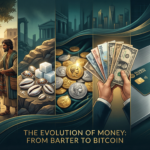
On May 22, 2010, a programmer named Laszlo Hanyecz paid 10,000 Bitcoin for two Papa John’s pizzas. At the time, that haul of digital tokens was worth about $41. Today, those same coins would be worth over $1 billion. That single transaction — equal parts absurd and visionary — captured something essential about the story of money itself: it has always been about what we collectively agree to believe in.
Long before Bitcoin, humans were wrestling with the same fundamental challenge: how do you trade your time, skills, and resources with someone else in a way that’s fair, efficient, and trustworthy? The answer has changed dramatically over ten millennia, from traded livestock to blockchain ledgers. But the underlying question has never changed.
Here is the full story.
AFFILIATE DISCLOSURE:
This article contains affiliate links. We may receive a commission for purchases made through these links, at no extra cost to you. We only recommend products and services we believe will genuinely help you achieve your financial goals.
Before Money: The Barter System and Its Limits
The oldest economic system humans used was simple: you give me what I need, I give you what you need. Barter — the direct exchange of goods and services without any medium — traces back at least to 6,000 BCE among Mesopotamian tribes, and was later adopted widely by Phoenician traders and ancient Egyptians.
Barter worked in small, tight-knit communities where everyone knew each other and traded regularly. But as societies grew more complex, its cracks became impossible to ignore. Economists identify three structural problems with pure barter:
- The Double Coincidence of Wants: A trade only happens if both parties want exactly what the other is offering at the same moment. A wheat farmer needing shoes must find a cobbler who happens to need wheat — right now.
- No Divisibility: You cannot cut a live cow in half to pay for a basket of apples without ruining the cow. Large-value goods are inherently difficult to divide into smaller units of exchange.
- No Common Measure of Value: Without a standard unit, every single transaction required fresh negotiation. How many apples equals one pair of shoes? The answer was always subjective.
Interestingly, modern anthropologists have complicated the neat “barter came first” narrative. Scholars like David Graeber have argued that in stateless societies, barter mostly occurred between strangers, not neighbors — and that within communities, credit relationships and reciprocal gift-giving were far more common than direct exchange. The textbook progression from barter to coins may be somewhat cleaner than the historical reality.
Commodity Money: When the Object Was the Currency
To work around barter’s limitations, early societies turned to commodity money — items that held widely agreed-upon, intrinsic value and could be exchanged for anything else. Because everyone accepted that these things had worth, they functioned as a de facto currency.
| Commodity | Where Used | Why It Worked |
| Cowrie Shells | Africa and Asia (from ~1200 BCE) | Durable, portable, hard to counterfeit |
| Salt | Ancient Rome | Essential preservative; gave us the word “salary” |
| Gold & Silver | Global | Rare, durable, divisible, and universally desired |
| Grain | Mesopotamia and Egypt | Staple food; stored and measured easily by weight |
Precious metals proved especially powerful: they were rare enough to hold value, durable enough not to spoil, and malleable enough to be shaped into standardized pieces. But hauling pouches of silver dust or chunks of gold still wasn’t exactly convenient — especially across long distances.
Coins: Standardization Changes Everything
The next leap came around 600 BCE in Lydia (modern-day Turkey), where the world’s first standardized coins were struck from electrum — a natural alloy of gold and silver. Stamped with the seal of the king to guarantee their weight and purity, Lydian coins solved the key problem of commodity money: you no longer had to weigh or test every piece of metal before trading.
The innovation spread rapidly. Athens minted the drachma, stamped with the owl of Athena, which became the dominant currency across the Aegean. Rome developed one of history’s most sophisticated monetary systems, complete with credit and banking infrastructure. Coins were not just economic tools — rulers quickly understood their political power, using currency to project authority and fund armies.
Coins were transformative for several reasons. They carried standardized, government-guaranteed value. They were small and portable, making long-distance trade far more practical. And because they bore an official stamp, they carried institutional trust that raw commodities never could.
Paper Money: China’s Five-Century Head Start
Paper money was invented in China — and the West was about five centuries late to the party. During the Tang Dynasty (618–907 CE), merchants began depositing heavy strings of coins at depository offices in exchange for lightweight paper receipts called “flying cash” (feiqian). These could be carried across China’s vast trade routes and redeemed for hard currency elsewhere.
The Northern Song Dynasty (960–1127 CE) took the concept further, issuing the world’s first true government-backed paper currency — the jiaozi — through a government office established in 1023 CE. Paper currency was in circulation in China roughly six centuries before Sweden issued the first European banknotes in 1661. Marco Polo, visiting the Yuan Dynasty in the 13th century, was so astonished by the Khan’s paper money system that his reports back in Europe were initially dismissed as fantasy.
But early paper money also carried an early warning about its dangers. The Song government, under pressure from costly wars, over-issued its notes. Between 1190 and 1240, the supply of the currency increased six-fold. Prices rose twenty-fold. The world’s first paper money crisis became the world’s first paper-money-fueled inflation catastrophe.
Fiat Money: The Power — and Peril — of Trust
For centuries, paper money was backed by physical gold or silver. You could, in theory, hand in your banknote and receive a set amount of precious metal. This “Gold Standard” offered stability, but it also chained economic growth to how much gold a country happened to have in its vaults.
The 20th century changed this fundamentally. The U.S. formally abandoned the Gold Standard in 1971 under President Nixon, completing a global shift to fiat money — currency backed not by any commodity, but by government decree and public trust. The U.S. dollar, the Euro, and the Japanese Yen are all fiat currencies.
The advantages were real: central banks gained the flexibility to manage money supply, respond to economic crises, and fund growth without being constrained by gold reserves. But the system also came with a brutally clear warning built into history.
In Weimar Germany in 1923, the government printed massive amounts of money to pay post-WWI reparations debts. The results were catastrophic. A loaf of bread that cost 163 marks at the end of 1922 cost 200 billion marks by late 1923. By November 1923, one U.S. dollar was worth 4.2 trillion German marks. Citizens were famously seen hauling wheelbarrows full of banknotes just to buy basic groceries — and some used stacks of paper currency as kindling, since it was cheaper to burn than wood.
The lesson of fiat money is that it works beautifully when governments are disciplined — and catastrophically when they are not. Trust, once broken, is nearly impossible to restore.
Cryptocurrencies: Rethinking Money from the Ground Up
In 2009, an anonymous developer writing under the name Satoshi Nakamoto released Bitcoin — a form of digital currency designed to operate without any central bank, government, or middleman. Instead, it ran on a decentralized network secured by cryptography and recorded on a public ledger called the blockchain.
Three properties made Bitcoin genuinely radical:
- Decentralization: No single institution controls it. The network is maintained by thousands of computers around the world simultaneously.
- Immutability: Transactions recorded on the blockchain cannot be altered or reversed, making fraud extremely difficult.
- Borderless transfer: You can send Bitcoin to anyone, anywhere, in minutes — without exchange rates, bank fees, or institutional permission.
The moment Bitcoin went from theoretical to real came on May 22, 2010 — now celebrated as “Bitcoin Pizza Day” — when programmer Laszlo Hanyecz paid 10,000 BTC for two Papa John’s pizzas. Those coins, worth roughly $41 at the time, would be worth over $1 billion today. Hanyecz himself later reflected: “It made it real for some people. I mean, it certainly did for me.”
Bitcoin remains highly volatile and is more commonly used as a store of value (“digital gold”) than a day-to-day currency. But its emergence has forced a fundamental rethinking of what money is — and who gets to issue it. Many governments are now exploring Central Bank Digital Currencies (CBDCs), attempting to combine the efficiency of crypto technology with the stability of government backing.
The Full Timeline: How Money Has Evolved
| Era | Form of Money | Key Innovation | Core Risk |
| ~6000 BCE | Barter | Direct exchange, no intermediary needed | Double coincidence of wants |
| ~3000 BCE onward | Commodity Money (shells, salt, metals) | Universally recognized value | Inconvenient to carry at scale |
| ~600 BCE onward | Standardized Coins | Government-guaranteed weight and purity | Easy to debase or clip |
| 7th century CE onward | Paper Money | Lightweight; backed by metal reserves | Over-issuance leads to inflation |
| 20th century–Present | Fiat Money | Flexible; not constrained by gold supply | Requires trust in institutions |
| 2009–Present | Cryptocurrencies | Decentralized; secured by cryptography | Volatility; regulatory uncertainty |
The Bottom Line
Every form of money in this timeline — from cowrie shells to Bitcoin — solved a problem its predecessor couldn’t. And every one of them worked for exactly one reason: enough people agreed it had value.
That’s the deeper truth about money. It is not a natural resource, a scientific fact, or a divine decree. It is a shared story — a social technology that works as long as we believe it does. The form keeps changing. The function never does.
As we move deeper into the digital age, money will undoubtedly keep evolving. But understanding where it came from — and the recurring pattern of innovation, trust, and occasional catastrophic failure — is essential context for anyone trying to navigate what comes next. If you want to go deeper, our articles on Bitcoin vs. Fiat Currency and The Future of Banking pick up exactly where this one leaves off.
Frequently Asked Questions
What was the real problem with the barter system?
The “double coincidence of wants” — the need for both parties to want exactly what the other has at exactly the same time — made barter impractical at scale. As anthropologist David Graeber and others have noted, even in ancient societies, credit relationships and communal reciprocity often filled the gap long before formal currency did.
Why did gold become the global standard for money?
Gold is rare enough to be scarce, durable enough not to corrode, divisible into standardized pieces, and universally recognized across cultures. It solved the portability and standardization problems of earlier commodity money while retaining intrinsic value.
What is the difference between representative money and fiat money?
Representative money (like early banknotes) was backed by physical gold or silver — you could exchange it for a fixed amount of the real thing. Fiat money has no such backing; its value rests entirely on government decree and public confidence.
Why did countries abandon the Gold Standard?
The Gold Standard limited how much money governments could issue to what gold they held in reserve. This made it impossible to respond flexibly to economic crises. Moving to fiat money gave central banks the tools to manage recessions, fund wars, and stimulate growth — at the cost of needing strong institutional discipline to avoid inflation.
Will cash become obsolete?
Possibly, but not imminently. Digital payments and cryptocurrencies are growing rapidly, but cash remains the only universally accessible, privacy-preserving, no-tech-required payment method. Many central banks are developing digital currencies (CBDCs) that may eventually replace physical cash — but the transition, if it happens, will likely take decades.
Is Bitcoin considered “real” money?
It depends on your definition. Bitcoin functions as a store of value and can be used as a medium of exchange, but its high price volatility and limited everyday acceptance mean it doesn’t yet meet the traditional economic definition of money for most people’s daily transactions. It is increasingly treated as a financial asset — often compared to digital gold.
Leave a Reply